what or how to ask jwish rabbi to understand ecclesiastes meanings?
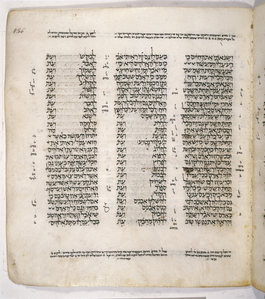
Ecclesiastes (; Hebrew: קֹהֶלֶת , qōheleṯ , Ancient Greek: Ἐκκλησιαστής, Ekklēsiastēs ) written c. 450–200 BCE, is 1 of the Ketuvim ("Writings") of the Hebrew Bible and ane of the "Wisdom" books of the Christian Old Testament. The championship commonly used in English is a Latin transliteration of the Greek translation of the Hebrew discussion קֹהֶלֶת ( Kohelet, Koheleth, Qoheleth or Qohelet ). An unnamed writer introduces "The words of Kohelet, son of David, king in Jerusalem" (1:one) and does non employ his own voice again until the final verses (12:9-14), where he gives his own thoughts and summarises the statements of "Kohelet"; the primary body of the text is ascribed to Kohelet himself.
Kohelet proclaims (1:two) "Vanity of vanities! All is futile!"; the Hebrew word hevel , "vapor", tin can figuratively mean "insubstantial", "vain", "futile", or "meaningless". Given this, the side by side poetry presents the basic existential question with which the rest of the book is concerned: "What profit hath a man for all his toil, in which he toils under the dominicus?", expressing that the lives of both wise and foolish people all end in death. While Kohelet endorses wisdom as a means for a well-lived earthly life, he is unable to ascribe eternal pregnant to information technology. In low-cal of this perceived senselessness, he suggests that man beings should relish the simple pleasures of daily life, such equally eating, drinking, and taking enjoyment in ane'due south work, which are gifts from the hand of God. The book concludes with the injunction to "Fright God and keep his commandments; for that is the all of mankind. Since every deed will God bring to judgment, for every hidden deed, be information technology expert or evil."
Championship [edit]
'Ecclesiastes' is a phonetic transliteration of the Greek word Ἐκκλησιαστής ( 'Ekklesiastes' ), which in the Septuagint translates the Hebrew proper noun of its stated author, Kohelet ( קֹהֶלֶת ). The Greek give-and-take derives from ekklesia (associates),[1] equally the Hebrew word derives from kahal (assembly),[2] but while the Greek word ways 'fellow member of an assembly',[three] the meaning of the original Hebrew give-and-take it translates is less certain.[iv] Equally Strong's concordance mentions,[v] it is a female agile participle of the verb kahal in its simple ( qal ) paradigm, a grade not used elsewhere in the Bible and which is sometimes understood every bit active or passive depending on the verb,[a] and then that Kohelet would mean '(female) assembler' in the active case (recorded equally such by Strong's concordance),[5] and '(female) assembled, member of an associates' in the passive case (as per the Septuagint translators). According to the majority understanding today,[4] the give-and-take is a more general ( mishkal , קוֹטֶלֶת ) form rather than a literal participle, and the intended meaning of Kohelet in the text is 'someone speaking before an associates', hence 'Teacher' or 'Preacher'.
Structure [edit]
Ecclesiastes is presented as the biography of "Kohelet" or "Qoheleth"; his story is framed by the vox of the narrator, who refers to Kohelet in the tertiary person, praises his wisdom, only reminds the reader that wisdom has its limitations and is not man's main business organization.[6] Kohelet reports what he planned, did, experienced and thought, but his journey to knowledge is, in the end, incomplete; the reader is not just to hear Kohelet's wisdom, but to detect his journey towards understanding and credence of life's frustrations and uncertainties: the journey itself is important.[vii]
Few of the many attempts to uncover an underlying structure to Ecclesiastes have met with widespread acceptance; amid them, the following is one of the more than influential:[8]
- Title (i:one)
- Initial poem (1:two–11)
- I: Kohelet's investigation of life (1:12–6:9)
- II: Kohelet's conclusions (6:10–eleven:6)
- Introduction (6:10–12)
- A: Man cannot observe what is good for him to do (vii:ane–viii:17)
- B: Man does not know what will come up subsequently him (9:1–eleven:6)
- Concluding poem (xi:7–12:eight)
- Epilogue (12:9–xiv)
Despite the acceptance past some of this structure, in that location have been many criticisms, such as that of Fox: "[Addison Yard. Wright'due south] proposed construction has no more effect on interpretation than a ghost in the attic. A literary or rhetorical construction should non merely 'be there'; it must practise something. It should guide readers in recognizing and remembering the writer's train of thought."[9]
Verse i:1 is a superscription, the ancient equivalent of a championship page: it introduces the volume as "the words of Kohelet, son of David, king in Jerusalem."[10]
Well-nigh, though not all, mod commentators regard the epilogue (12:9–14) as an addition past a later on scribe. Some have identified certain other statements every bit further additions intended to make the book more religiously orthodox (e.thousand., the affirmations of God'southward justice and the need for piety).[11]
It has been proposed that the text is composed of 3 distinct voices. The first belongs to Qoheleth equally the prophet, the "true voice of wisdom",[12] which speaks in the beginning person, recounting wisdom through his own experience. The 2d vox belongs to Qoheleth as the rex of Jerusalem, who is more didactic and thus speaks primarily in second-person imperative statements. The 3rd vocalism is that of the epilogist, who speaks proverbially in the third person. The epilogist is nigh identified in the book's offset and final verses. Kyle R. Greenwood suggests that following this structure, Ecclesiastes should be read as a dialogue betwixt these voices.[12]
Summary [edit]
The ten-poetry introduction in verses ane:2–11 are the words of the frame narrator; they set the mood for what is to follow. Kohelet's bulletin is that all is meaningless.[ten]
Subsequently the introduction come the words of Kohelet. As king, he has experienced everything and washed everything, but concludes that nothing is ultimately reliable, equally death levels all. Kohelet states that the simply proficient is to partake of life in the present, for enjoyment is from the hand of God. Everything is ordered in time and people are bailiwick to time in dissimilarity to God'due south eternal character. The globe is filled with injustice, which just God will adjudicate. God and humans practice not belong in the same realm, and information technology is therefore necessary to take a correct attitude before God. People should enjoy, but should not be greedy; no-one knows what is skillful for humanity; righteousness and wisdom escape humanity. Kohelet reflects on the limits of human power: all people face expiry, and death is better than life, but people should relish life when they tin. The world is total of risk: he gives advice on living with risk, both political and economic. Mortals should take pleasure when they tin, for a time may come up when no i can. Kohelet's words stop with imagery of nature languishing and humanity marching to the grave.[13]
The frame narrator returns with an epilogue: the words of the wise are difficult, but they are practical as the shepherd applies goads and pricks to his flock. The ending of the book sums upwards its message: "Fear God and keep his commandments for God will bring every human activity to judgement."[14] Some scholars propose 12:thirteen–14 were an addition by a more orthodox author than the original writer;[15] [xvi] others think it is likely the work of the original writer.[17]
Composition [edit]
[edit]

Colorized version of King Solomon in Former Age by Gustave Doré (1866); a depiction of the purported author of Ecclesiastes, according to rabbinic tradition.
The volume takes its proper name from the Greek ekklesiastes , a translation of the title past which the fundamental figure refers to himself: "Kohelet", meaning something like "ane who convenes or addresses an assembly".[eighteen] Co-ordinate to rabbinic tradition, Ecclesiastes was written by Male monarch Solomon in his erstwhile age[nineteen] (an alternative tradition that "Hezekiah and his colleagues wrote Isaiah, Proverbs, the Song of Songs and Ecclesiastes" probably ways merely that the book was edited under Hezekiah),[20] simply critical scholars have long rejected the idea of a pre-exilic origin.[21] [22] According to Christian tradition, the book was probably written by another Solomon (Gregory of Nyssa wrote that it was written by another Solomon;[23] Didymus the Blind wrote that information technology was probably written past several authors[24]). The presence of Persian loanwords and Aramaisms points to a date no earlier than virtually 450 BCE,[six] while the latest possible date for its composition is 180 BCE, when the Jewish writer Ben Sira quotes from information technology.[25] The dispute as to whether Ecclesiastes belongs to the Western farsi or the Hellenistic periods (i.due east., the earlier or afterward part of this flow) revolves around the degree of Hellenization (influence of Greek culture and idea) present in the book. Scholars arguing for a Persian appointment (c. 450–330 BCE) hold that in that location is a complete lack of Greek influence;[half dozen] those who argue for a Hellenistic appointment (c. 330–180 BCE) argue that information technology shows internal evidence of Greek thought and social setting.[26]
Likewise unresolved is whether the author and narrator of Kohelet are one and the same person. Ecclesiastes regularly switches betwixt third-person quotations of Kohelet and first-person reflections on Kohelet'due south words, which would indicate the book was written every bit a commentary on Kohelet's parables rather than a personally-authored repository of his sayings. Some scholars have argued that the third-person narrative structure is an bogus literary device along the lines of Uncle Remus, although the description of the Kohelet in 12:8–14 seems to favour a historical person whose thoughts are presented by the narrator.[27] The question, however, has no theological importance,[27] and i scholar (Roland Potato) has commented that Kohelet himself would have regarded the time and ingenuity put into interpreting his volume equally "one more than case of the futility of human attempt".[28]
Genre and setting [edit]
Ecclesiastes has taken its literary grade from the Centre Eastern tradition of the fictional autobiography, in which a character, oft a king, relates his experiences and draws lessons from them, often self-critical: Kohelet also identifies himself as a king, speaks of his search for wisdom, relates his conclusions, and recognises his limitations.[7] The book belongs to the category of wisdom literature, the trunk of biblical writings which give advice on life, together with reflections on its problems and meanings—other examples include the Volume of Job, Proverbs, and some of the Psalms. Ecclesiastes differs from the other biblical Wisdom books in beingness deeply skeptical of the usefulness of wisdom itself.[29] Ecclesiastes in turn influenced the deuterocanonical works, Wisdom of Solomon and Sirach, both of which contain vocal rejections of the Ecclesiastical philosophy of futility.
Wisdom was a pop genre in the ancient world, where it was cultivated in scribal circles and directed towards immature men who would take up careers in high officialdom and royal courts; there is strong evidence that some of these books, or at least sayings and teachings, were translated into Hebrew and influenced the Book of Proverbs, and the author of Ecclesiastes was probably familiar with examples from Egypt and Mesopotamia.[30] He may besides have been influenced past Greek philosophy, specifically the schools of Stoicism, which held that all things are fated, and Epicureanism, which held that happiness was best pursued through the tranquillity tillage of life's simpler pleasures.[31]
Canonicity [edit]
The presence of Ecclesiastes in the Bible is something of a puzzle, as the common themes of the Hebrew canon—a God who reveals and redeems, who elects and cares for a chosen people—are absent from it, which suggests that Kohelet had lost his faith in his old age. Understanding the book was a topic of the primeval recorded discussions (the hypothetical Council of Jamnia in the 1st century CE). One argument advanced at that time was that the proper name of Solomon carried enough authorisation to ensure its inclusion; however, other works which appeared with Solomon's name were excluded despite being more orthodox than Ecclesiastes.[32] Some other was that the words of the epilogue, in which the reader is told to fright God and keep his commands, made information technology orthodox; but all later attempts to detect annihilation in the rest of the book that would reverberate this orthodoxy have failed. A mod suggestion treats the book every bit a dialogue in which different statements belong to dissimilar voices, with Kohelet himself answering and refuting unorthodox opinions, merely there are no explicit markers for this in the book, as at that place are (for example) in the Book of Job.
Yet another suggestion is that Ecclesiastes is just the most extreme example of a tradition of skepticism, only none of the proposed examples match Ecclesiastes for a sustained denial of faith and dubiety in the goodness of God. Martin A. Shields, in his 2006 book The End of Wisdom: A Reappraisal of the Historical and Canonical Function of Ecclesiastes, summarized that "In short, we do non know why or how this volume found its way into such esteemed company".[33]
Themes [edit]
Scholars disagree about the themes of Ecclesiastes: whether it is positive and life-affirming, or deeply pessimistic;[34] whether it is coherent or incoherent, insightful or confused, orthodox or heterodox; whether the ultimate message of the volume is to re-create Kohelet, the wise man, or to avert his errors.[35] At times Kohelet raises deep questions; he "doubted every aspect of religion, from the very ideal of righteousness, to the by now traditional thought of divine justice for individuals".[36] Some passages of Ecclesiastes seem to contradict other portions of the Erstwhile Attestation, and fifty-fifty itself.[34] The Talmud even suggests that the rabbis considered censoring Ecclesiastes due to its seeming contradictions.[37] I suggestion for resolving the contradictions is to read the volume as the tape of Kohelet'southward quest for knowledge: opposing judgments (e.chiliad., "the dead are meliorate off than the living" (four:two) vs. "a living dog is amend off than a dead lion" (ix:four)) are therefore provisional, and it is only at the conclusion that the verdict is delivered (eleven–12:7). On this reading, Kohelet'southward sayings are goads, designed to provoke dialogue and reflection in his readers, rather than to attain premature and self-bodacious conclusions.[38]
The subjects of Ecclesiastes are the pain and frustration engendered by observing and meditating on the distortions and inequities pervading the world, the uselessness of homo ambition, and the limitations of worldly wisdom and righteousness. The phrase "nether the sun" appears twenty-9 times in connection with these observations; all this coexists with a firm belief in God, whose power, justice and unpredictability are sovereign.[39] History and nature move in cycles, so that all events are anticipated and unchangeable, and life, without the sun, has no meaning or purpose: the wise man and the homo who does non written report wisdom will both die and be forgotten: human should be reverent ("Fear God"), only in this life it is best to simply enjoy God'south gifts.[31]
Judaism [edit]
In Judaism, Ecclesiastes is read either on Shemini Atzeret (past Yemenites, Italians, some Sepharadim, and the mediaeval French Jewish rite) or on the Shabbat of the Intermediate Days of Sukkot (past Ashkenazim). If there is no Intermediate Sabbath of Sukkot, Ashkenazim too read it on Shemini Atzeret (or, in State of israel, on the outset Shabbat of Sukkot). It is read on Sukkot every bit a reminder not to go too caught upward in the festivities of the holiday, and to deport over the happiness of Sukkot to the rest of the year past telling the listeners that, without God, life is meaningless.
The final poem of Kohelet[40] has been interpreted in the Targum, Talmud and Midrash, and by the rabbis Rashi, Rashbam and ibn Ezra, as an allegory of old age.
Catholicism [edit]
Ecclesiastes has been cited in the writings of past and current Catholic Church building leaders. For instance, Doctors of the Church have cited Ecclesiastes. St. Augustine of Hippo cited Ecclesiastes in Volume 20 of City of God.[41] Saint Jerome wrote a commentary on Ecclesiastes.[42] St. Thomas Aquinas cited Ecclesiastes ("The number of fools is infinite.") in his Summa Theologica .[43]
The 20th-century Catholic theologian and cardinal-elect Hans Urs von Balthasar discusses Ecclesiastes in his work on theological aesthetics, The Celebrity of the Lord. He describes Qoheleth as "a disquisitional transcendentalist avant la lettre ", whose God is distant from the world, and whose kairos is a "grade of fourth dimension which is itself empty of meaning". For Balthasar, the function of Ecclesiastes in the Biblical canon is to represent the "concluding trip the light fantastic toe on the part of wisdom, [the] decision of the ways of man", a logical cease-point to the unfolding of human wisdom in the Old Testament that paves the way for the advent of the New.[44]
The book continues to be cited by recent popes, including Pope John Paul II and Pope Francis. Pope John Paul Ii, in his full general audience of October 20, 2004, called the author of Ecclesiastes "an aboriginal biblical sage" whose clarification of death "makes frantic clinging to earthly things completely pointless".[45] Pope Francis cited Ecclesiastes on his address on September 9, 2014. Speaking of vain people, he said, "How many Christians live for appearances? Their life seems like a lather bubble."[46]
Influence on Western literature [edit]
Ecclesiastes has had a deep influence on Western literature. It contains several phrases that have resonated in British and American culture, such as "eat, drink and be merry", "nothing new under the sun", "a time to be built-in and a time to die", and "vanity of vanities; all is vanity".[47] American novelist Thomas Wolfe wrote: "[O]f all I have ever seen or learned, that book seems to me the noblest, the wisest, and the about powerful expression of homo's life upon this earth—and also the highest flower of poetry, eloquence, and truth. I am not given to dogmatic judgments in the affair of literary cosmos, but if I had to make one I could say that Ecclesiastes is the greatest single slice of writing I take ever known, and the wisdom expressed in it the near lasting and profound."[48]
- The opening of William Shakespeare'southward Sonnet 59 references Ecclesiastes one:9–10.
- Line 23 of T. S. Eliot's "The Waste Land" alludes to Ecclesiastes 12:v.
- Christina Rossetti's "One Certainty" quotes from Ecclesiastes 1:2–9.
- Leo Tolstoy's Confession describes how the reading of Ecclesiastes affected his life.
- Robert Burns' "Address to the Unco Guid" begins with a verse entreatment to Ecclesiastes 7:16.
- The championship of Ernest Hemingway's starting time novel The Sunday Too Rises comes from Ecclesiastes 1:5.
- The title of Edith Wharton's novel The House of Mirth was taken from Ecclesiastes 7:four ("The heart of the wise is in the house of mourning; but the middle of fools is in the house of mirth.").
- The championship of Laura Lippman'southward novel Every Secret Matter and that of its flick adaptation come up from Ecclesiastes 12:xiv ("For God shall bring every work into judgment, with every secret thing, whether it be good, or whether it be evil.").
- The main graphic symbol in George Bernard Shaw'due south brusque story The Adventures of the Black Girl in Her Search for God [49] meets Koheleth, "known to many as Ecclesiastes".
- The title and theme of George R. Stewart's post-apocalyptic novel Earth Abides is from Ecclesiastes 1:4.
- In the dystopian novel Fahrenheit 451, Ray Bradbury'due south primary character, Montag, memorizes much of Ecclesiastes and Revelation in a world where books are forbidden and burned.
- Pete Seeger'southward song "Turn! Plow! Turn!" takes all but one of its lines from the Book of Ecclesiastes chapter iii.
- The passage in chapter iii, with its repetition of "A fourth dimension to ..." has been used every bit a title in many other cases, including the novels A Time to Trip the light fantastic by Melvyn Bragg and A Time to Kill past John Grisham, the records ...And a Time to Dance by Los Lobos and A Time to Love by Stevie Wonder, and films A Fourth dimension to Love and a Time to Die, A Time to Alive and A Time to Kill.
- The opening quote in the moving-picture show Platoon past Oliver Stone is taken from Ecclesiastes 11:9.
- The essay "Politics and the English Language" by George Orwell uses Ecclesiastes 9:11 equally an case of clear and vivid writing, and "translates" information technology into "modern English of the worst sort" to demonstrate common fallings of the latter.
Run across as well [edit]
- Bible
- Q, novel by Luther Blissett
- A Rose for Ecclesiastes
- Tanakh
- "Plow! Plough! Turn!"
- Vanitas
- Vier ernste Gesänge
- Wisdom of Sirach
- The Song
Notes [edit]
- ^ As opposed to the hifil class, always agile 'to gather', and niphal form, always passive 'to exist assembled' - both forms often used in the Bible.
Citations [edit]
- ^ "Greek Give-and-take Study Tool". www.perseus.tufts.edu . Retrieved 2020-07-28 .
- ^ "Potent'due south Hebrew: 6951. קָהָל (qahal) -- assembly, convocation, congregation". biblehub.com . Retrieved 2020-07-29 .
- ^ "Greek Word Study Tool". www.perseus.tufts.edu . Retrieved 2020-07-28 .
- ^ a b Even-Shoshan, Avraham (2003). Even-Shoshan Lexicon. pp. Entry "קֹהֶלֶת".
- ^ a b "H6953 קהלת - Strong's Hebrew Lexicon". studybible.info . Retrieved 2020-07-28 .
- ^ a b c Seow 2007, p. 944.
- ^ a b Fox 2004, p. xiii.
- ^ Fox 2004, p. sixteen.
- ^ Fox 2004, p. 148-149.
- ^ a b Longman 1998, pp. 57–59.
- ^ Fox 2004, p. xvii.
- ^ a b GREENWOOD, KYLE R. (2012). "Debating Wisdom: The Role of Voice in Ecclesiastes". The Catholic Biblical Quarterly. 74 (three): 476–491. ISSN 0008-7912. JSTOR 43727985.
- ^ Seow 2007, pp. 946–57.
- ^ Seow 2007, pp. 957–58.
- ^ Ross, Allen P.; Shepherd, Jerry E.; Schwab, George (vii March 2017). Proverbs, Ecclesiastes, Vocal of Songs. Zondervan Academic. p. 448. ISBN978-0-310-53185-2.
- ^ Alter, Robert (2018-12-eighteen). The Hebrew Bible: A Translation with Commentary (Vol. Three-Volume Prepare). Westward. W. Norton & Company. ISBN978-0-393-29250-3.
- ^ Weeks 2007, pp. 428–429.
- ^ Gilbert 2009, pp. 124–25.
- ^ Brown 2011, p. 11.
- ^ Smith 2007, p. 692.
- ^ Play tricks 2004, p. x.
- ^ Bartholomew 2009, pp. 50–52.
- ^ Wright 2014, p. 287.
- ^ Wright 2014, p. 192.
- ^ Trick 2004, p. 14.
- ^ Bartholomew 2009, pp. 54–55.
- ^ a b Bartholomew 2009, p. 48.
- ^ Ingram 2006, p. 45.
- ^ Brettler 2007, p. 721.
- ^ Trick 2004, pp. x–11.
- ^ a b Gilbert 2009, p. 125.
- ^ Diderot, Denis (1752). "Catechism". Encyclopedia of Diderot & d'Alembert - Collaborative Translation Projection: 601–04. hdl:2027/spo.did2222.0000.566.
- ^ Shields 2006, pp. 1–five.
- ^ a b Bartholomew 2009, p. 17.
- ^ Enns 2011, p. 21.
- ^ Hecht, Jennifer Michael (2003). Doubt: A History. New York: HarperCollins. pp. 75. ISBN978-0-06-009795-0.
- ^ Babylonian Talmud Shabbat 30b. sfn error: no target: CITEREFBabylonian_Talmud_Shabbat_30b (help)
- ^ Brown 2011, pp. 17–18.
- ^ Flim-flam 2004, p. ix.
- ^ Ecclesiastes 12:1–8
- ^ Augustine. "Book XX". The Metropolis of God.
- ^ Jerome. Commentary on Ecclesiastes.
- ^ Aquinas, Thomas. Summa Theologica.
- ^ von Balthasar, Hans Urs (1991). The Celebrity of the Lord. Volume VI: Theology: The Old Covenant. Translated by Brian McNeil and Erasmo Leiva-Merikakis. Edinburgh: T&T Clark. pp. 137–43.
- ^ Manhardt, Laurie (2009). Come up and See: Wisdom of the Bible. Emmaus Road Publishing. p. 115. ISBN9781931018555.
- ^ Pope Francis. "Pope Francis: Vain Christians are like soap bubbles". Radio Vatican . Retrieved 2015-09-09 .
- ^ Hirsch, E.D. (2002). The New Dictionary of Cultural Literacy . Houghton Mifflin Harcourt. p. 8. ISBN0618226478.
- ^ Christianson 2007, p. seventy.
- ^ Shaw, Bernard (2006). The adventures of the black girl in her search for God. London: Hesperus. ISBN1843914220. OCLC 65469757.
References [edit]
- Bartholomew, Craig M. (2009). Ecclesiastes. Baker Academic. ISBN9780801026911.
- Wright, Robert. (2014). Proverbs, Ecclesiastes, Song of Solomon. ISBN978-0830897346.
- Brettler, Marker Zvi (2007). "The Poetical and Wisdom Books". In Coogan, Michael D. (ed.). The New Oxford Annotated Bible (3rd ed.). Oxford University Press. ISBN9780195288803.
- Brown, William P. (2011). Ecclesiastes: Interpretation: A Bible Commentary for Didactics and Preaching. Westminster John Knox Press. ISBN9780664238247.
- Christianson, Eric South. (2007). Ecclesiastes Through the Centuries. Wiley-Blackwell. ISBN9780631225294.
- Coogan, Michael D. (2008). The Sometime Testament: A Very Brusque Introduction. Oxford Academy Printing. ISBN9780199719464.
- Diderot, Denis (1752). "Canon". The Encyclopedia of Diderot & d'Alembert Collaborative Translation Project. Translated by Susan Emanuel (2006). hdl:2027/spo.did2222.0000.566. Trans. of "Canon",Encyclopédie ou Dictionnaire raisonné des sciences, des arts et des métiers, vol. 2. Paris, 1752.
- Eaton, Michael (2009). Ecclesiastes: An Introduction and Commentary. IVP Academic. Archived from the original on 2016-03-04. Retrieved 2013-01-07 .
- Enns, Peter (2011). Ecclesiastes. Eerdmans. ISBN9780802866493.
- Fredericks, Daniel C.; Estes, Daniel J. (2010). Ecclesiastes & the Vocal of Songs. IVP Bookish. Archived from the original on 2016-03-03. Retrieved 2013-01-07 .
- Play a trick on, Michael V. (2004). The JPS Bible Commentary: Ecclesiastes. Jewish Publication Society. ISBN9780827609655.
- Gilbert, Christopher (2009). A Consummate Introduction to the Bible: A Literary and Historical Introduction to the Bible. Paulist Printing. ISBN9780809145522.
- Hecht, Jennifer Michael (2003). Doubt: A History. New York: HarperCollins. ISBN978-0-06-009795-0.
- Ingram, Doug (2006). Ambiguity in Ecclesiastes. Continuum. ISBN9780567027115.
- Krüger, Thomas (2004). Qohelet: A Commentary. Fortress. ISBN9780800660369.
- Longman, Tremper (1998). The Volume of Ecclesiastes. Eerdmans. ISBN9780802823663.
- Ricasoli, Corinna, ed. (2018). The Living Dead: Ecclesiastes through Art. Ferdinand Schöningh. ISBN 9783506732767.
- Rudman, Dominic (2001). Determinism in the Book of Ecclesiastes. Sheffield Bookish Press. ISBN9780567215635.
- Seow, C.Fifty. (2007). "Ecclesiastes". In Coogan, Michael D. (ed.). The New Oxford Annotated Bible (3rd ed.). Oxford Academy Printing. ISBN9780195288803.
- Shields, Martin A. (2006). The Terminate of Wisdom: A Reappraisal of the Historical and Canonical Office of Ecclesiastes. Eisenbrauns. ISBN9781575061023.
- Smith, James (1996). The Wisdom Literature and Psalms. College Press. ISBN9780899004396.
- Smith, James E. (Baronial 2007). The Wisdom Literature and Psalms. College Press. ISBN978-0-89900-954-four.
- Weeks, Stuart (25 January 2007). Barton, John; Muddiman, John (eds.). The Oxford Bible Commentary. Oxford Academy Printing. ISBN978-0-19-927718-6.
External links [edit]
- Kohelet – Ecclesiastes (Judaica Press) translation [with Rashi'due south commentary] at Chabad.org
- Ecclesiastes: New Revised Standard Version
- Ecclesiastes: Douay Rheims Bible Version
- Ecclesiastes at Wikisource (Authorised King James Version)
- Ecclesiastes at United States Briefing of Catholic Bishops (New American Bible)
- Ecclesiastes at Bible Gateway (New Male monarch James Version)
- A Metaphrase of the Book Of Ecclesiastes past Gregory Thaumaturgus.
-
 Ecclesiastes public domain audiobook at LibriVox – Various versions
mcdanielhason1965.blogspot.com
Source: https://en.wikipedia.org/wiki/Ecclesiastes
0 Response to "what or how to ask jwish rabbi to understand ecclesiastes meanings?"
Post a Comment