How Long After Hurricane Matthew 2016 Were Beaches Good Again
Overview
Hurricane Michael started as typical weak October Caribbean tropical system. However, subsequently approximately a week of slow development, the arrangement moved into warm Gulf of United mexican states waters and quickly intensified into a major hurricane as it moved north towards the Florida Panhandle. Subsequently a 2-twenty-four hour period long intensification period over the eastern Gulf, Michael fabricated landfall (Figure 1) as an unprecedented (for the region) category 5 hurricane (on the Saffir-Simpson Hurricane Current of air Calibration). Michael fabricated landfall nearly Tyndall Air Forcefulness Base in the Florida Panhandle with maximum sustained air current speed of 140 knots (161 mph) and a minimum pressure level 919 mb. Based on minimum pressure, Michael is the fourth most-powerful hurricane to hit the United States, behind the Labor Day Hurricane (1935), Hurricane Camille (1969) and Hurricane Andrew (1992), and the nigh powerful tempest to affect the Florida Panhandle in recorded history. The tempest caused catastrophic impairment from wind and storm surge, particularly in the Panama Urban center Beach to Mexico Beach to Cape San Blas areas. The widespread catastrophic harm spread well inland every bit Hurricane Michael remained at category 3 forcefulness into southwest Georgia.
| Visible Satellite Loop of Hurricane Michael Courtesy of Rick Kohrs (UW/SEEC) |
Early Life
Michael originated from an area of enhanced convection associated with a wide area of low force per unit area that developed in the southwestern Caribbean (approximately 200 miles due north of Panama). At that fourth dimension, the National Hurricane Center (NHC) characterized the system as disorganized and having little convective activity. Although surface force per unit area was relatively low compared to the systems surround, highly unfavorable upper-level winds hampered the quick development of this tempest.
During the side by side ii days, convection associated with the tropical disturbance continued to increase and get amend organized. As the system moved northwest into the northwestern Caribbean Sea, it produced torrential rainfall and gusty winds across portions of Central America. By 5:00 pm EDT on six October satellite imagery and surface observations indicated the depression pressure level area had get meliorate divers and the convection more organized. NHC issued it'due south beginning advisory on the system, Potential Tropical Cyclone 14, that would somewhen become Hurricane Michael. The forecast indicated the development of this storm into a high-end Tropical Storm before landfall (Figure ii).
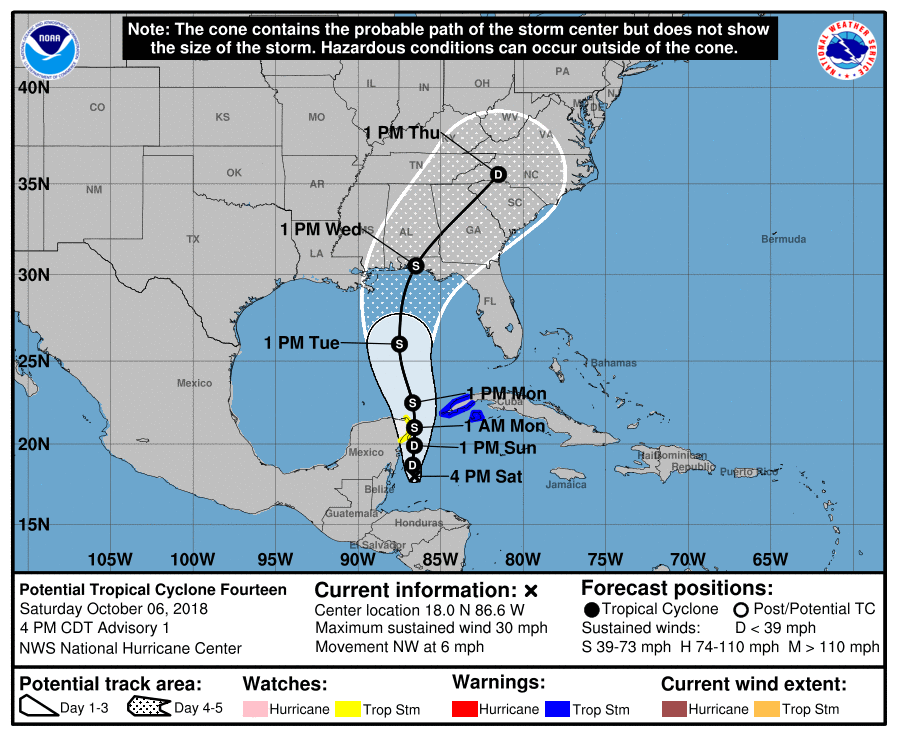 |
| Effigy two: Track forecast equally indicated from the get-go informational issued on Hurricane Michael |
As the system continued to organize, the threat for a potentially dangerous hurricane landfall somewhere along the northeastern Gulf Coast increased. Well-nigh operational models used by the NHC (e.g., GFS, UKMET, HWRF, etc.) were in skilful agreement that the storm would intensify into peradventure a category ane hurricane or stronger before landfall. As a result, the NWS office in Tallahassee began communicating the elevated threat of this system to the northern Gulf of Mexico Coast. The Area Forecast Discussions (AFD) issued on half dozen October included entries such equally: "probabilities keep to increase that the Gulf Coast will be impacted with a tropical cyclone mid to late calendar week" and urged folks to brand certain their hurricane season preparations are in "expert shape". The degree of confidence of the impacts were already being communicated every bit well: "there is loftier confidence that at to the lowest degree a tropical storm volition be impacting somewhere forth the northern Gulf coast during the middle of the week, and hurricane intensity is within the realm of possibilities."
Despite twenty to 30 knots (23 to 35 mph) of westerly wind shear, radar data from Belize and infrared satellite imagery indicated the arrangement had connected to develop through the rest of the day. Past 7 Oct 5:00 am EDT the system was upgraded a Tropical Depression. ASCAT data revealed that low level circulation was becoming better organized and the arrangement was displaying maximum winds of up to 35 knots (xl mph). Only 8 hours afterwards becoming a depression, the NHC upgraded the system to Tropical Storm Michael. Tropical storm force winds and torrential downpours were affecting portions of coastal east-fundamental Yucatan Peninsula. Michael was showing no signs of weakening as confidence of an bear upon somewhere along the Florida Big Bend and/or Panhandle increased as seen in Figure 3.
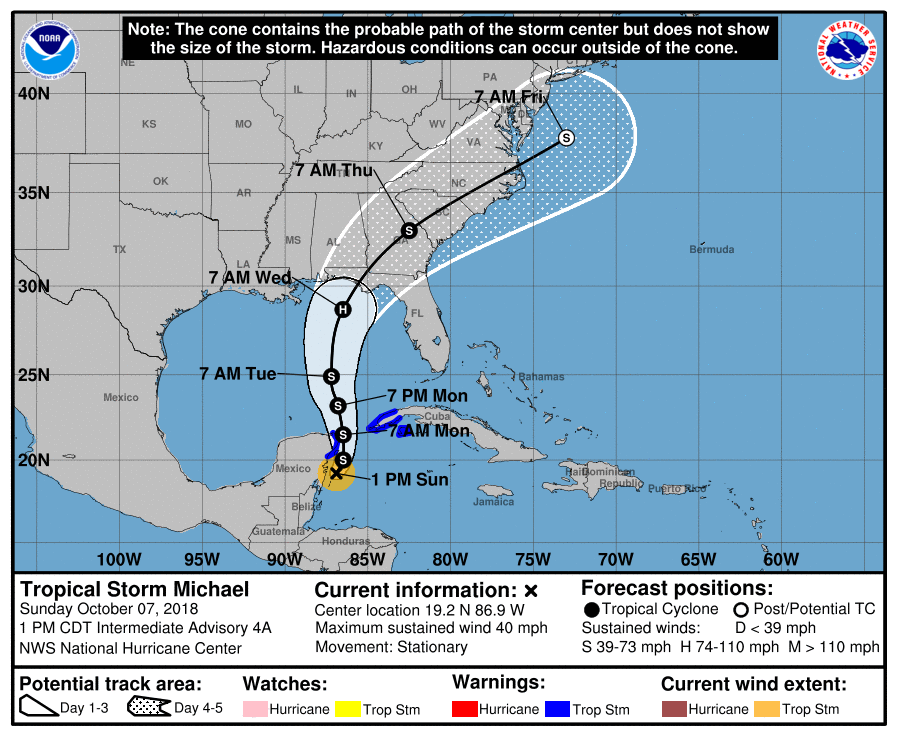 |
| Figure 3: Track forecast issued at 2pm 7 October as Michael became a Tropical Tempest |
Intensification Period
On viii October at eleven AM EDT (two days prior to landfall) the NHC upgraded Michael to category 1 status and issued a Hurricane Lookout man for the entire Florida Big Bend and Panhandle coastline. From this point on, Michael was on a fast-rails to becoming a major hurricane as it headed generally north across the eastern Gulf of Mexico. Favorable conditions including anomalously warm sea-surface temperatures, weakening environmental shear, and abundant atmospheric moisture all played a major part during its quick intensification. In less than 48 hours Michael deepened from a Category i to a high-finish Category 4 on 10 Oct at 2 AM EDT. Table 1 summarizes the quick spin-upward of the tempest during this time.
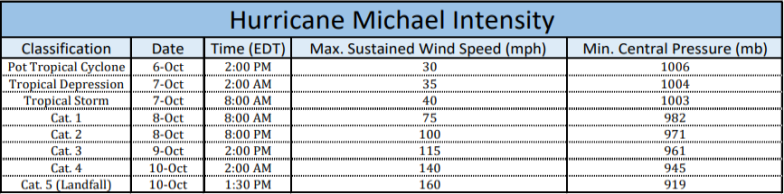 |
| Tabular array 1: Hurricane Michael intensification chart |
Two large-calibration atmospheric features paved the way for this system every bit it moved towards the Panhandle. Early on, a large ridge of loftier pressure which was located over much of the Eastern seaboard created a southerly to southeasterly period which forced Michael in a general NWN to NW direction. By nine October (~24 hours prior to landfall) a large-scale mid-latitude trough of low pressure level nosed its way east across the Continental U.S. The southwesterly menstruum around the eastern edge of the trough eventually steered Michael northeast and towards the Panama Metropolis / Mexico Beach area. In full general, the organization moved at a steady 11 mph across the Gulf of Mexico. The shift in Michael's path from a northwesterly to northeasterly direction can be depicted in Effigy 4.
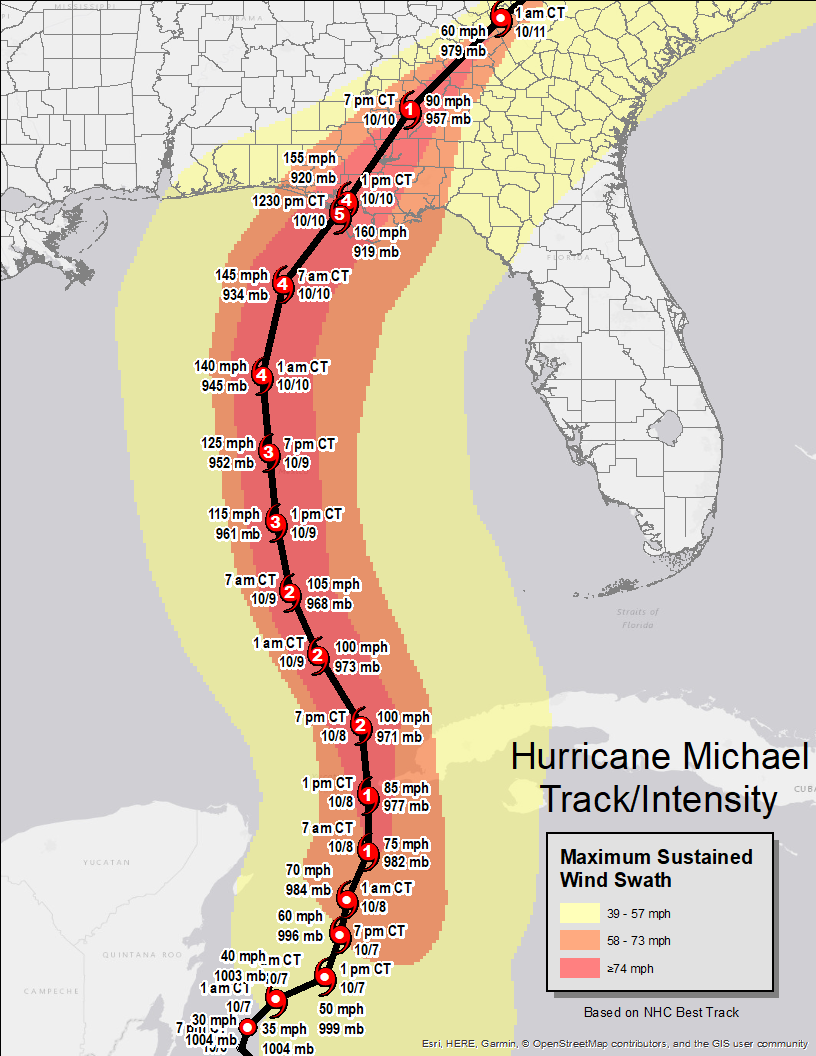 |
| Effigy iv: Preliminary track and intensity of Hurricane Michael |
As mentioned earlier, this tempest fell nada brusk of extraordinary when it came to intensification. Throughout the day on eight October, Michael continued to become more organized on satellite imagery. This was in part due to the weakening of an upper-level shortwave trough which was located just northwest of the storm. Equally the trough weakened, vertical wind shear values began to decrease and allowed the tempest to become more vertically stacked. With almost no other environmental factors impeding the development of this arrangement Michael underwent rapid intensification.
Perhaps the biggest ecology cistron favoring its rapid intensification were the very warm Gulf waters ahead of the storm. A month before the germination of Michael, Florida experienced its warmest September (statewide average) on record equally determined by the National Center for Environmental Data. Consequently, sea surface temperatures (SSTs) reached anomalously warm values of around 2 – 4 ⁰F (ane – 2 ⁰C) above average. This left Michael with an important free energy reservoir to tap into as information technology moved beyond the Gulf of Mexico. Anomalously warm SSTs ahead of Michael's path are depicted in Figure 5.
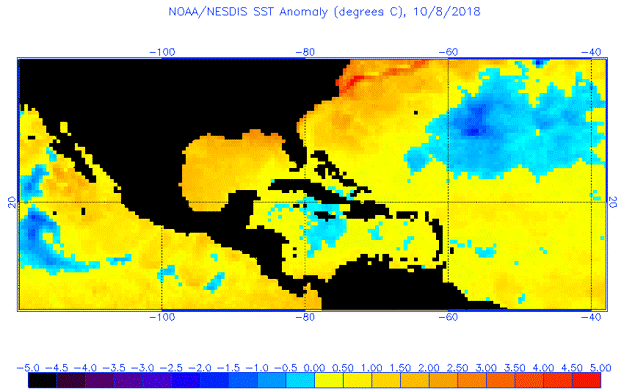 |
| Figure 5: 8 October 2018 ocean surface temperature anomalies equally measured by NOAA NESDIS satellite |
Another environmental gene that potentially helped Michael intensify speedily may be attributed to the upper level trough that steered the storm NW simply before landfall. Normally, mid-breadth systems such every bit troughs bring very unfavorable ecology conditions for tropical cyclones (i.e., potent upper-level shear). However, inquiry has shown that in particular cases these systems can provide upper-level divergence. This departure aloft acts as a means of ventilation which favors air to get out and flow abroad from the superlative of a hurricane. This in turn favors a convective feedback processes which assist storms deepen and intensify. Figure 6 depicts the rapid intensification of Michael equally it approached landfall. Organization of the eyewall and immigration within the eye are representative of storm intensification.
| Figure 6: Infrared satellite imagery of Hurricane Michael as it tracks towards the Florida Panhandle |
Landfall
Michael fabricated landfall along the Florida Panhandle well-nigh Tyndall Air Force Base (AFB) around 1:30 pm EDT (12:30 pm CDT) on Midweek, October 10, 2018 as a category 5 hurricane, with maximum sustained wind speeds of 140 knots (161 mph) and a minimum cardinal pressure of 919 millibars (mb) . Both Air Forcefulness Reserve Hurricane Hunter Aircraft and NWS WSR-88D radar data showed that Michael was nevertheless intensifying upon landfall. The Hurricane Hunters estimated a 700mb (approximately 8,000 feet) flight-level height wind of 152 kts (when wind speeds are adapted from flight-level to surface-level, this is around 137 knots) on their final pass through the storm at 1:23 pm EDT (12:23 pm CDT). At the surface, a top current of air gust of 139 mph was measured at Tyndall AFB earlier the sensor failed.
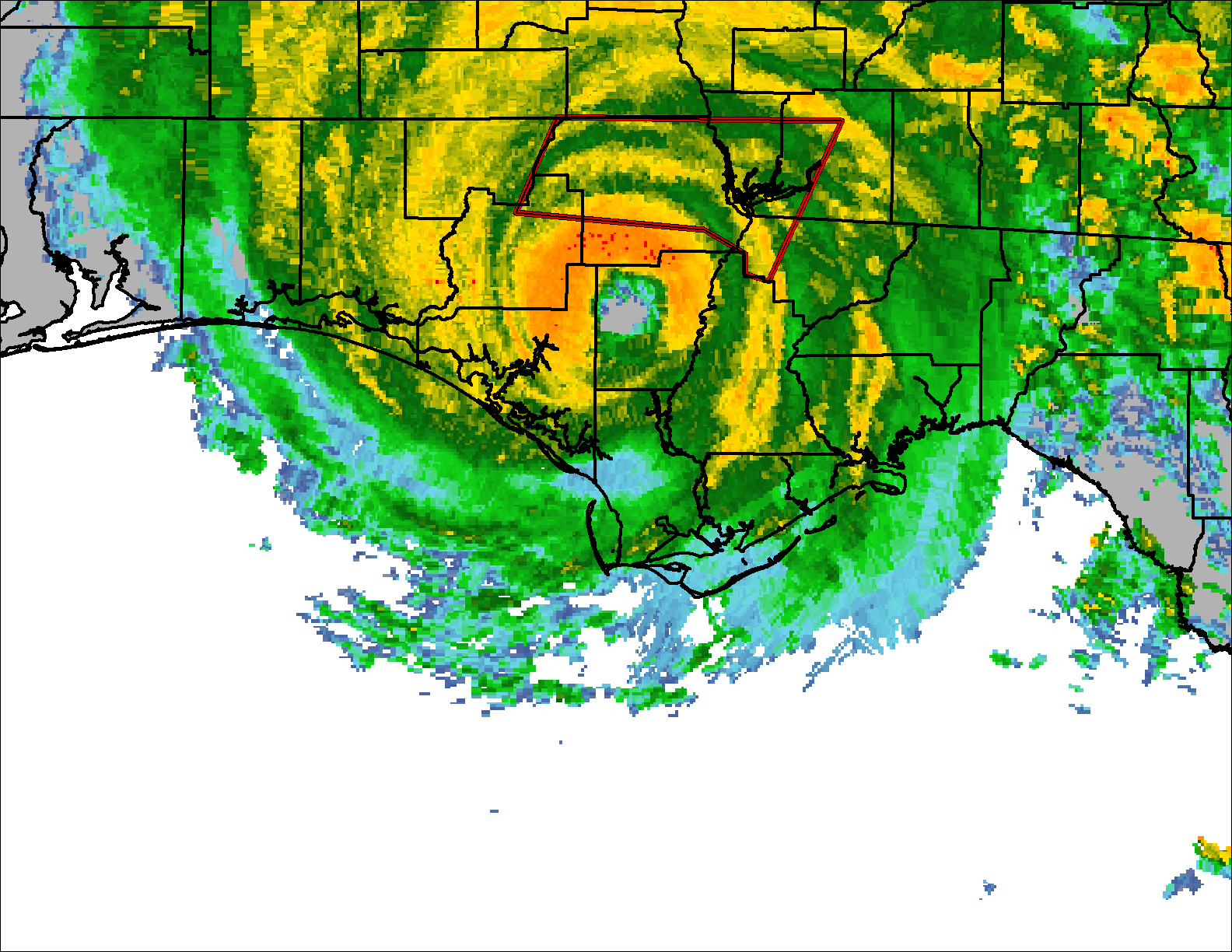
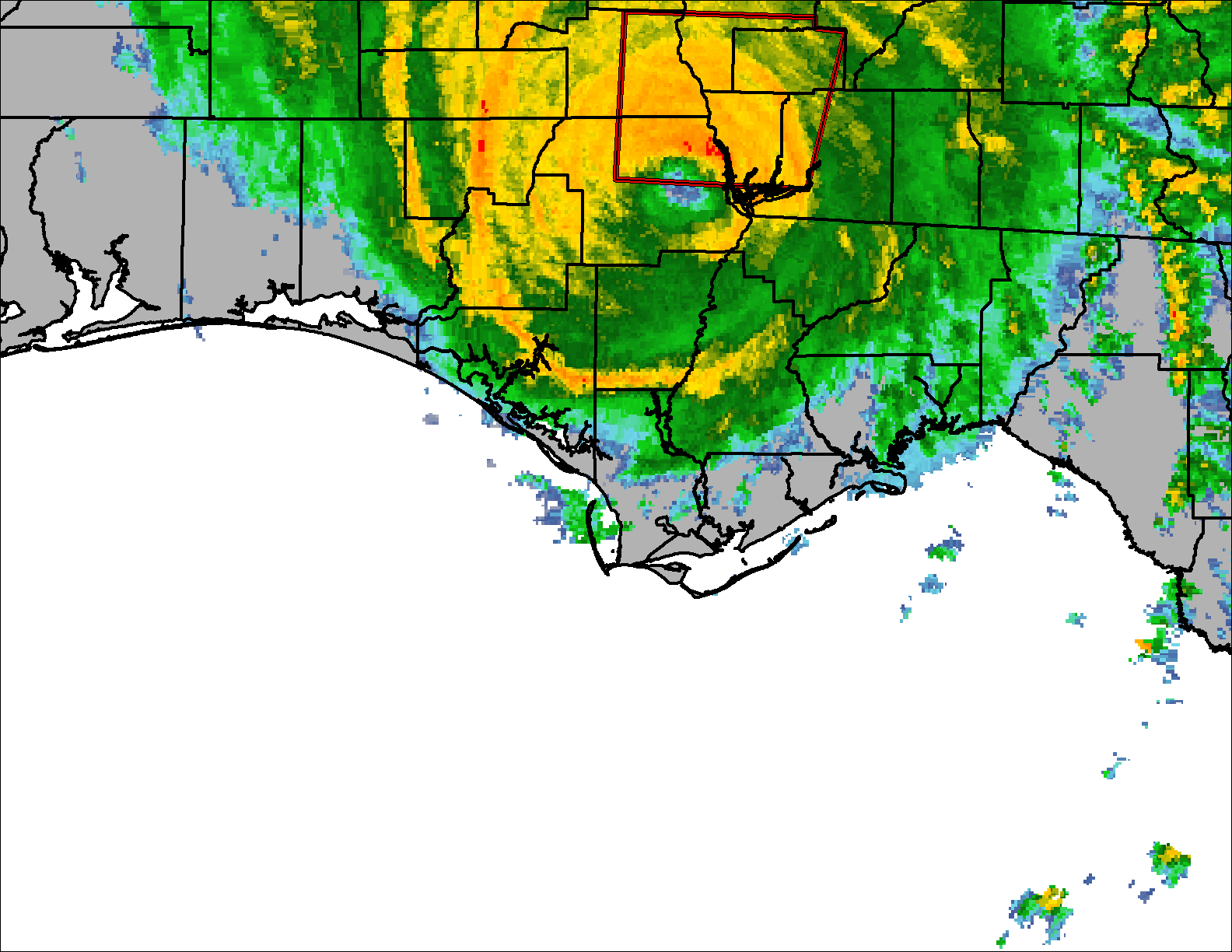
In response to these potent winds, the NWS role in Tallahassee issued its start ever Farthermost Wind Warning (EWW), a warning that is very rarely used inside the NWS. The warning was issued at xi:eleven am EDT and encompassed the entirety of Gulf Canton, Southern Bay County, and Southwestern Franklin County. Presently after, three more EWWs were issued as the storm progressed inland. Even counties such equally Seminole in Georgia and Houston in Alabama had EWWs.
| Effigy 7: Visible satellite imagery of Hurricane Michael as the storm makes landfall nigh Mexico Embankment, FL |
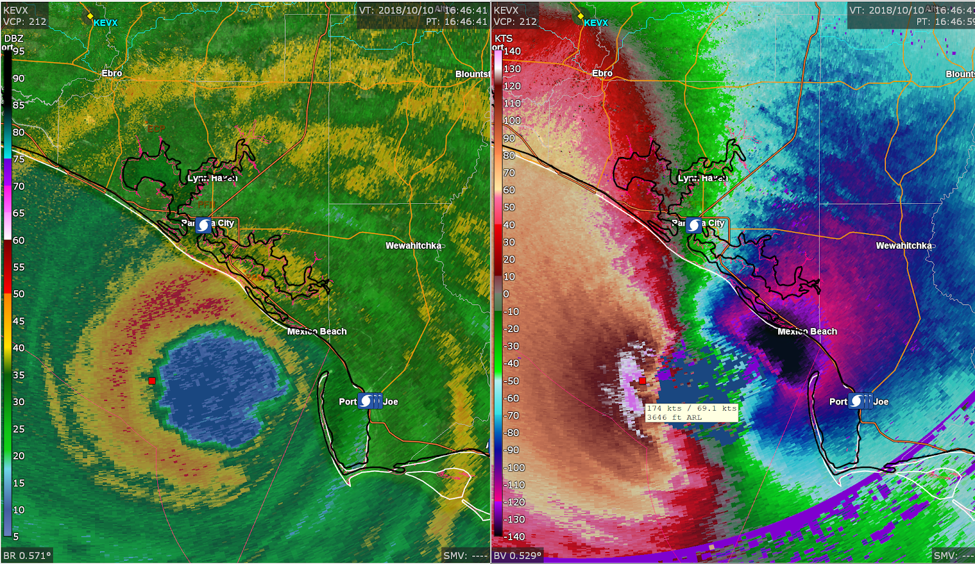 |
| Figure 8: KEOX radar reflectivity (left) and velocity (right) of Hurricane Michael's eye as the tempest made landfall |
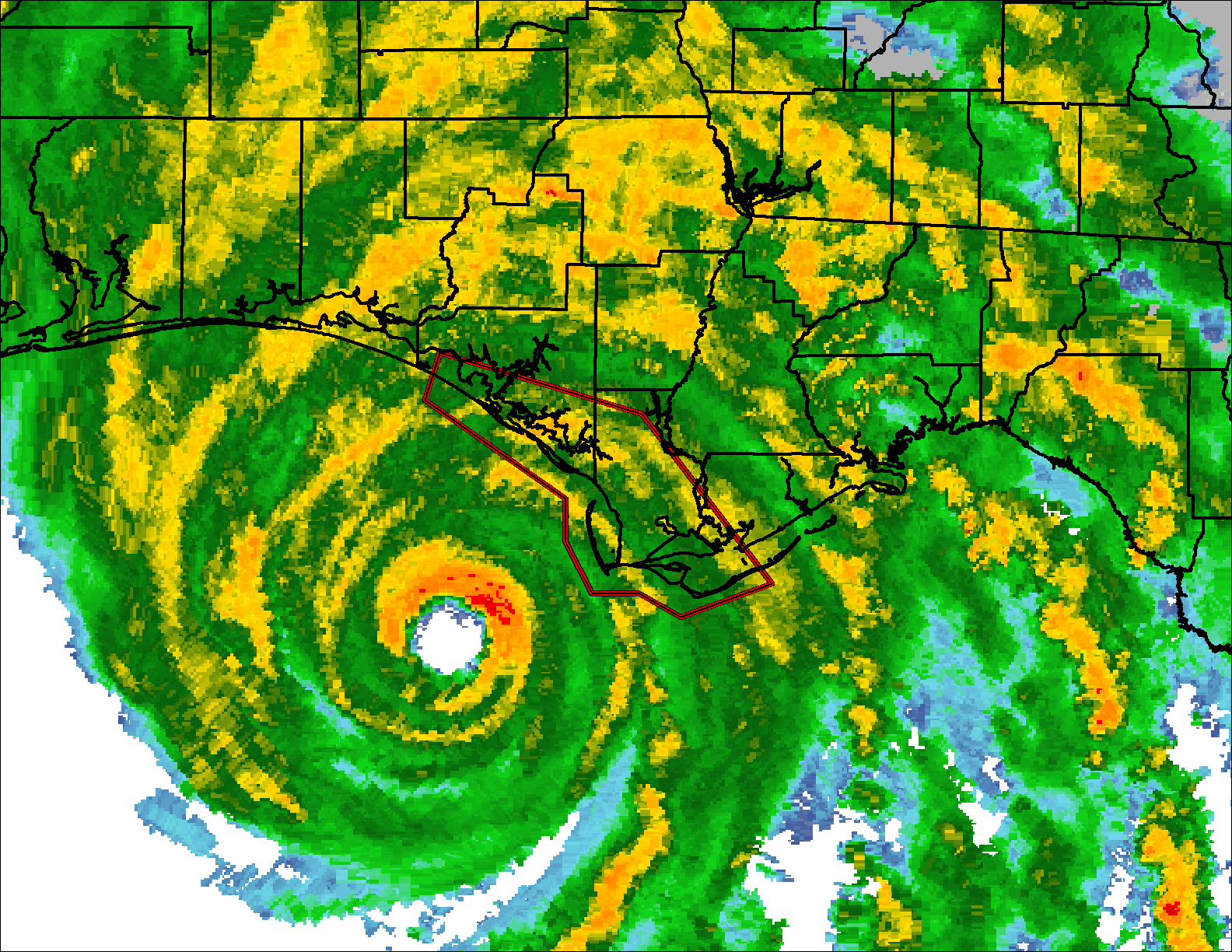 | 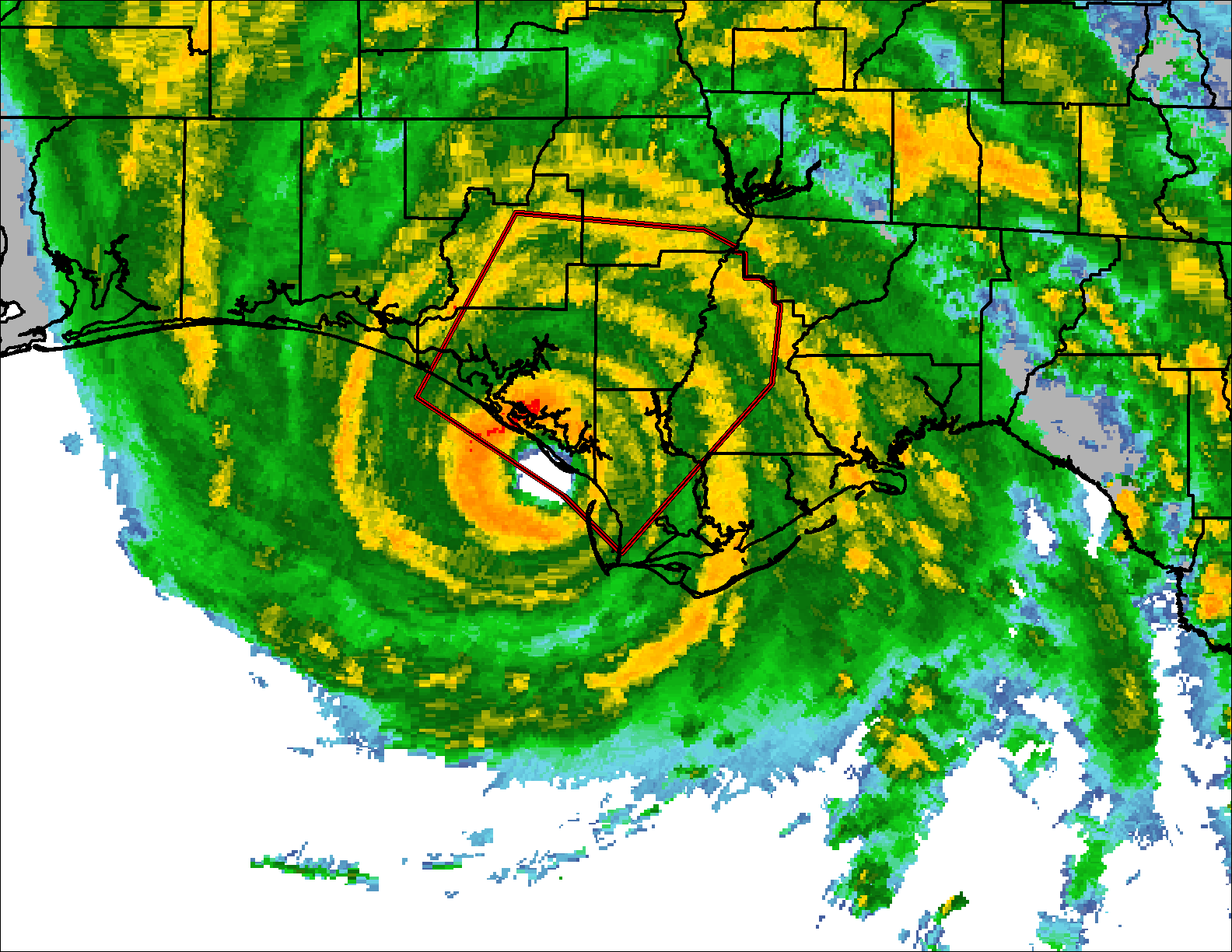 |  |  |
| 10:11 CDT | 12:15 CDT | 2:09 CDT | iii:xl CDT |
| Figure 9: Extreme Wind Warnings | |||
EWWs so far inland were warranted given that Michael remained a strong hurricane as it tracked inland. The centre crossed into Seminole County, GA, around six:00 pm EDT as a category 3 hurricane, traveling forward at 13 mph with maximum sustained air current speeds of 115 mph. It weakened to a Category 2 hurricane past seven:00 pm EDT equally it traveled across southern Georgia, with maximum sustained wind speeds of 100 mph. Michael became a tropical storm around 12:00 am EDT on October 11, with the center located over central Georgia. With the catastrophic winds tracking well inland, the strong winds were observed well into Georgia. Donaldsonville, GA which is located approximately 80 mi from the location of landfall, experienced a gust of 115 mph. It is very rare to see storms maintain their intensity this well then far inland.
Hurricane Michael was truly a unique issue. Since 1851, and prior to Hurricane Michael, simply 9 major hurricanes have made landfall over the Florida Panhandle (Figure 10). Michael, as it stands now, is the virtually powerful storm to impact the Florida Panhandle in recorded history.
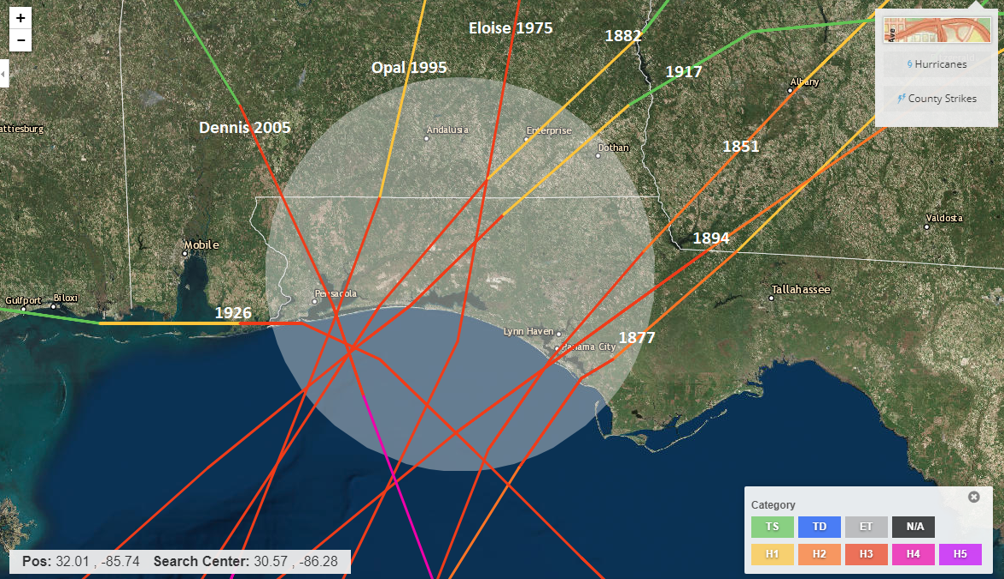 |
| Figure 10: Graphic depicting all tropical cyclones (category 3 or college) to have fabricated landfall over the Florida Panhandle before Hurricane Michael |
Storm Surge
Hurricane Michael brought catastrophic storm surge to the Florida Panhandle and Big Bend areas. One of the hardest striking locations was from Mexico Beach to Indian Pass where ix to 14 feet of superlative tempest surge flood was observed. In improver, wave activeness caused even higher total h2o values and this resulted in waves destroying the 2nd story of multiple buildings in United mexican states Beach.
At St. Joseph Peninsula State Park on Greatcoat San Blas, the tempest surge cutting through the peninsula, creating two inlets, resulting in portions of the park no longer being accessible past vehicle. These new inlets truly demonstrate the ability of storm surge.
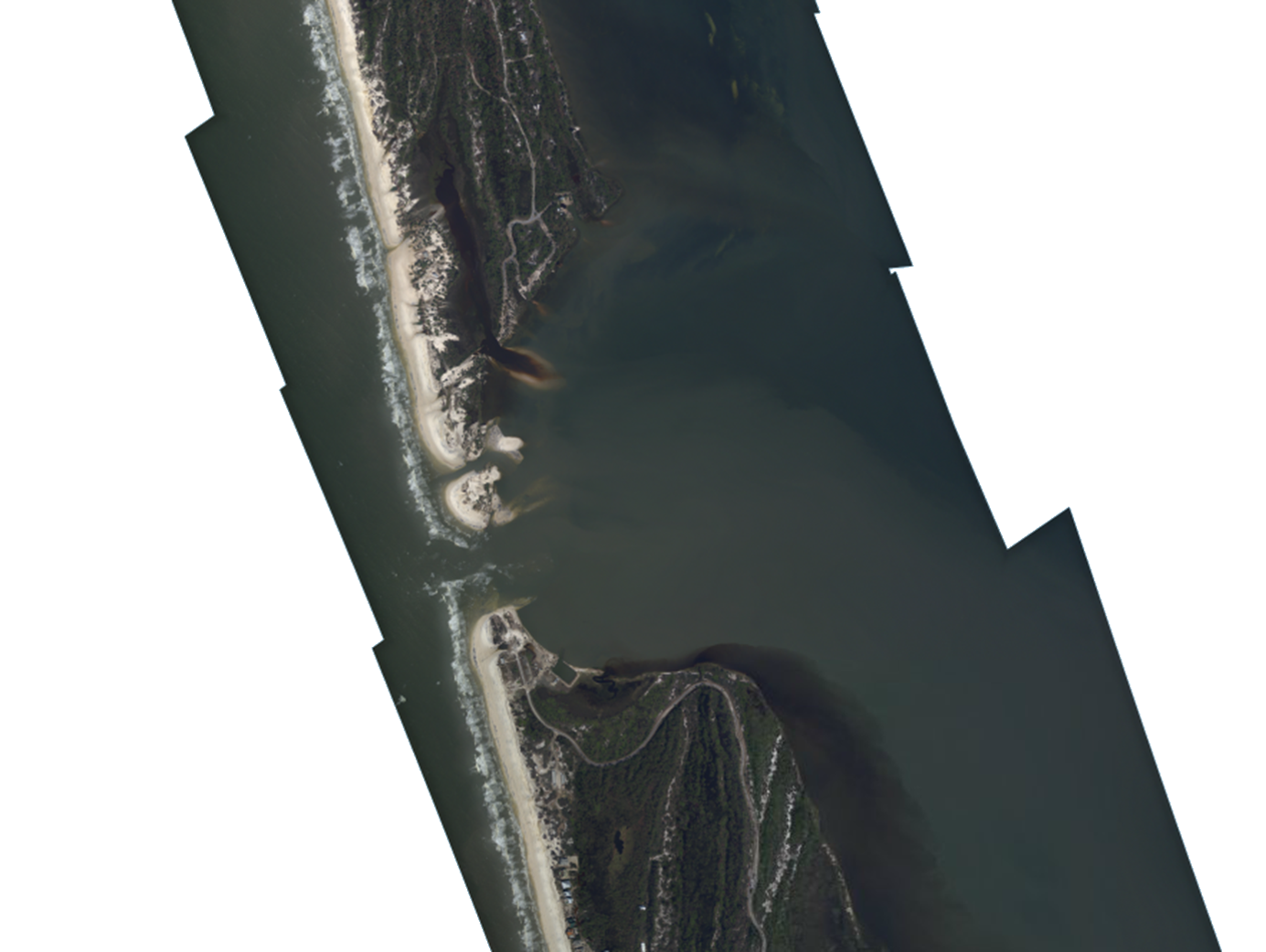 |
| Ii new inlets cutting at St. Joseph State Park |
While preliminary peak storm surge inundation was slightly less due east of Indian Pass, values were still life-threatening and caused pregnant damage. Forth the declension, portions of U.Due south. 98 and Alligator Drive were washed out and had to be patched/repaved. In Carrabelle, water was high enough to enter a eating place, resulting in harm to piece of furniture. In improver, numerous homes along the declension were destroyed or damaged as water slammed confronting the structures.
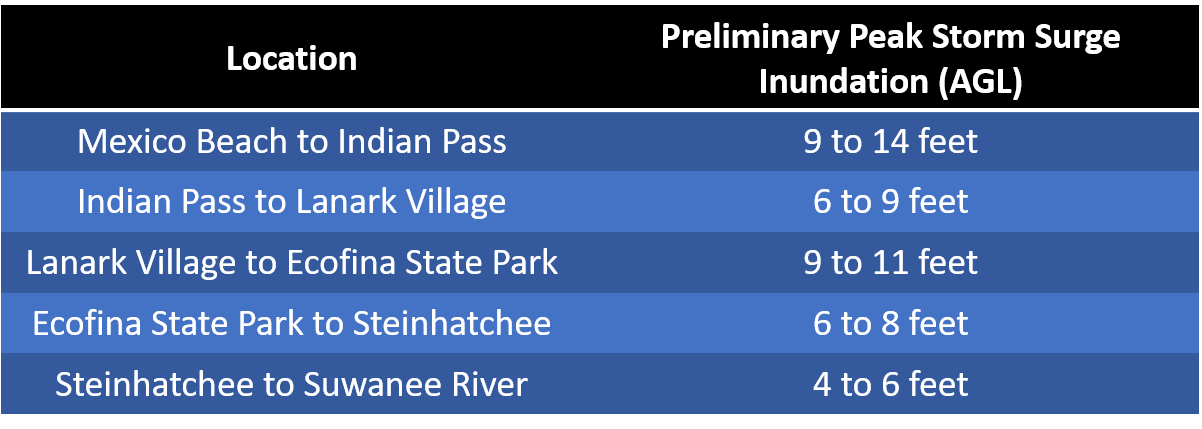 |
| Preliminary Peak Storm Surge Inundation Values (AGL) |
Current of air
In addition to the life-threatening storm surge, structural damage was extensive, particularly across the Florida Panhandle. Preliminary information assessments indicate virtually fifty,000 structures were affected across the Florida Panhandle, western Big Bend, southwest Georgia and southeast Alabama. Of these, more than 3,000 structures were destroyed. Homes and businesses were not the only structures impacted. The Hurricane Michael Preliminary Virtual Assessment Team (P-VAT) report from the Structural Farthermost Event Reconnaissance Network indicated that two hospitals in Bay Canton, Bay Medical Sacred Heart and Gulf Coast Regional Medical Center likewise sustained significant damage. One hospital had drinking glass cleft and cladding stripped off the building while the other hospital had issues with power and water. Tyndall Air Force Base (AFB), that experienced the eye of Hurricane Michael, experienced catastrophic damage with every building on base experiencing some roof damage. A nearby simple school had a portion of its roof ripped off. During the tiptop of the storm, before the transmission stopped, a sensor at Tyndall AFB measured a gust to 139 mph.
The wind damage was not confined to the coastline, but extended well inland. In Marianna, businesses lost their roofs and the exterior wall of some buildings collapsed as the roof was lost. In Donalsonville, GA, where a 115mph gust was measured, roof impairment was as well observed and at least 1 silo was flipped over. Even in Albany, GA, signs were blown down and roofs were peeled off buildings.
In addition to extensive structural impairment, hurricane force winds caused widespread power outages across a large portion of the tri-country region. Most 100% of customers across a big portion of the Florida Panhandle lost ability, with some of these outages lasting weeks. These widespread power outages extended into southwest Georgia with 100% of customers losing ability all the way up to Lee County, GA!
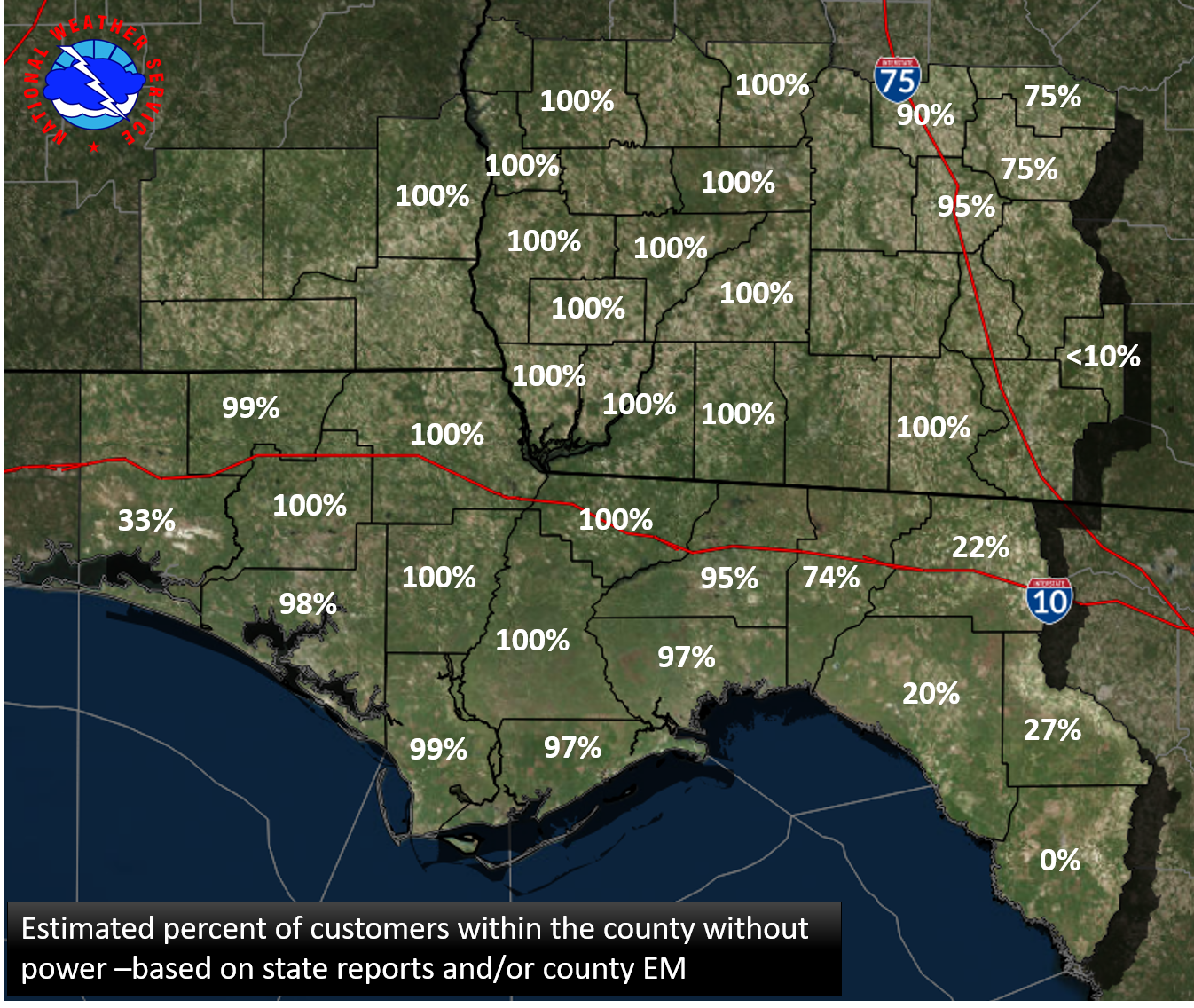 |
| Estimated percent of customers in county without power |
The catastrophic winds also resulted in damage to the timber and agricultural communities across Florida and Georgia. Co-ordinate to the Florida Forest Service, in Florida, timber damage costs estimates were over $ane.2 billion dollars with almost 3 meg acres of forested land damaged. In addition to damage costs, replanting in the more than severely damaged areas could be an addition $240 million. This damage besides has impacts to the wildfire potential with boosted forest fuels from downed trees. More than on the timber impacts in Florida can be found in the Florida Forest Service report.
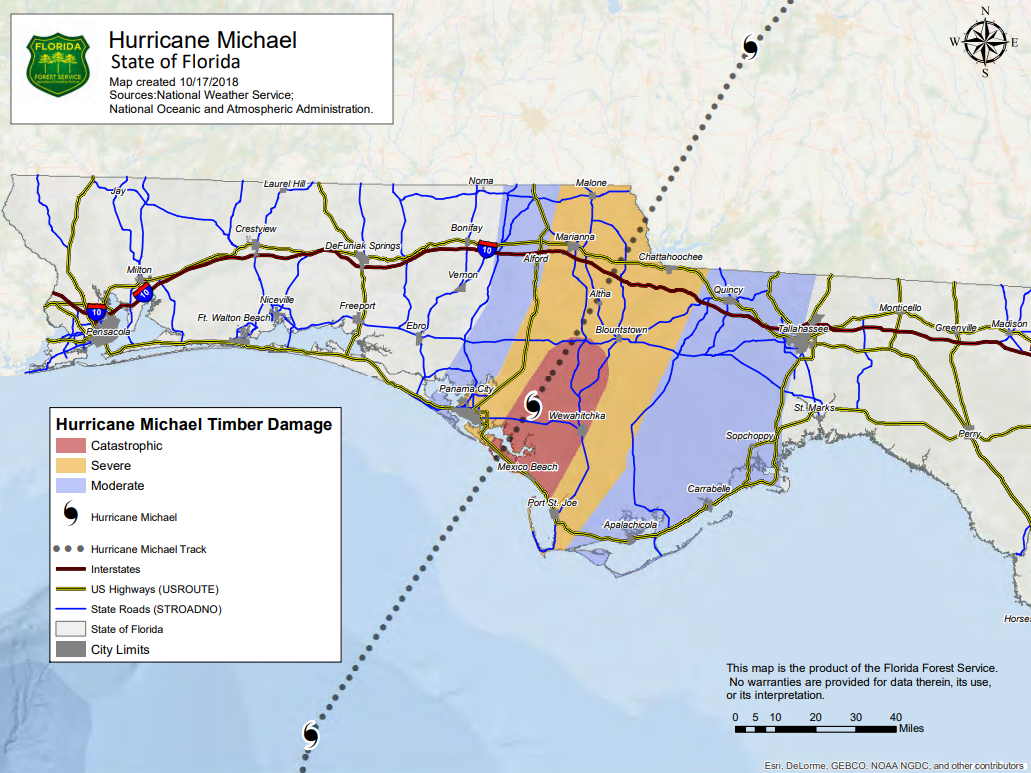 |
| Florida Timber Damage Courtesy of the Florida Woods Service |
The catastrophic timber loss was non confined to Florida, but in fact, extended into Georgia where across the state of Georgia, 2,368,226 acres of forestland was impacted by Hurricane Michael. The estimated value of this land is $762,683,909. Catastrophic damage was mainly confined to Seminole, Decatur and Miller Counties with severe damage extending into Dougherty and Terrell Counties. More on the timber impacts in Georgia can be found from the Georgia Forestry Commission.
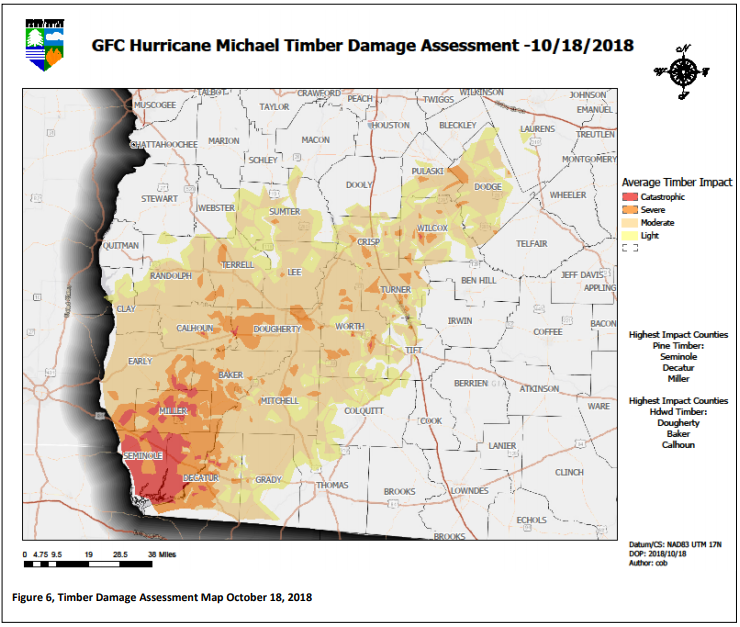 |
| Georgia Timber Impairment Courtesy of the Georgia Forestry Committee |
Inland Flooding
Inland flooding associated with Hurricane Michael across the tri-country region was limited equally the hurricane rapidly tracked beyond the area. A maximum rainfall full of 6.84 inches was observed near Crossroads, GA (Quitman Canton) with the second highest amount for the region recorded in Calhoun County, FL with 6.66 inches. With these higher rainfall amounts isolated, just a few areas of inland flooding were observed. In Bay County, record flooding was observed on the Econfina Creek at State Road 20 with 26.17 feet (NAVD88). This resulted in the SR-xx bridge being overtopped. In addition, in Calhoun County, FL, moderate flooding occurred on the Chipola River nearly Altha. A few homes were impacted downstream from the gauge and significant impairment was sustained to the fish camps along the river.
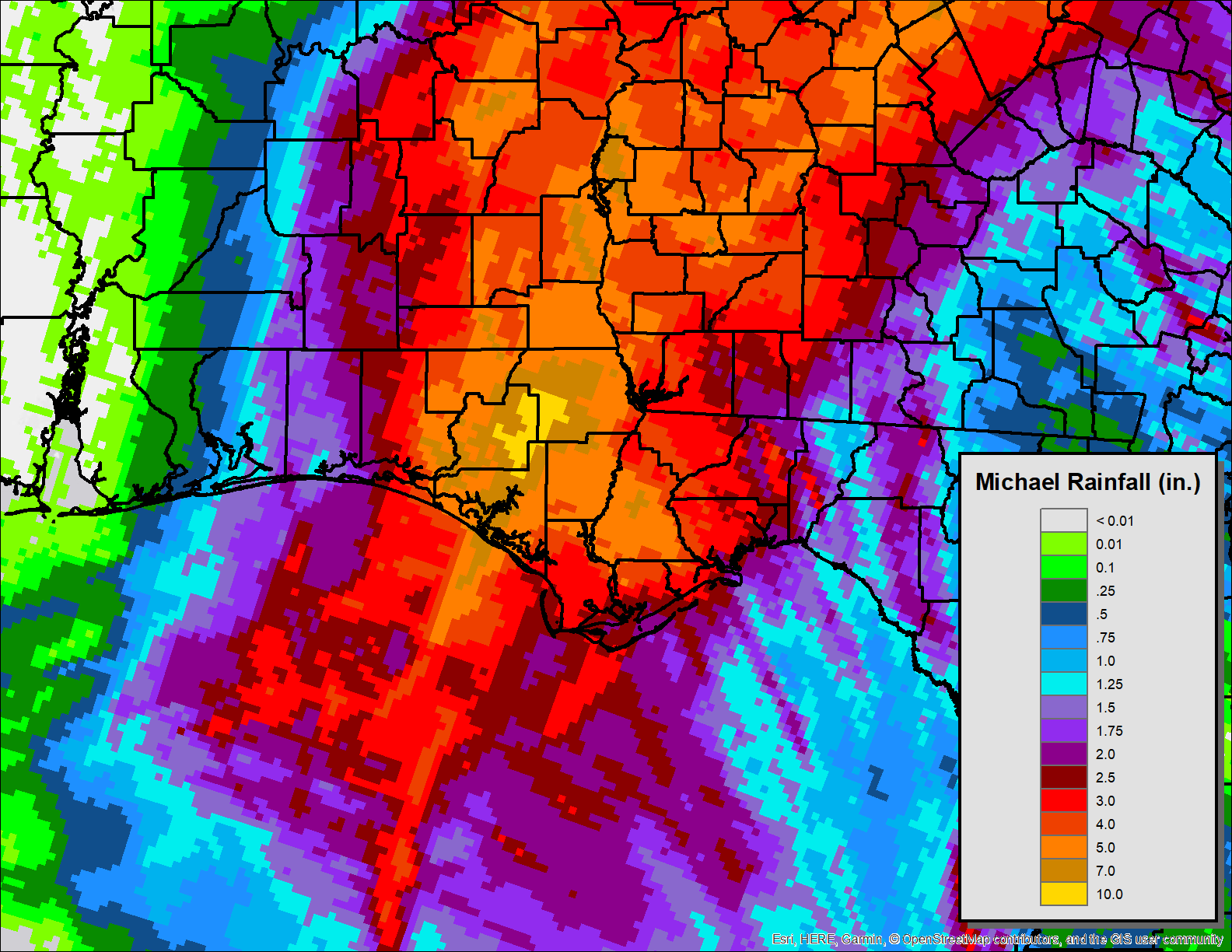 |
| Observed Rainfall During Hurricane Michael |
Tornadoes
There were no recorded tornadoes across the Florida Panhandle, Big Bend, southwest Georgia or southeast Alabama associated with Hurricane Michael.
Fatalities
Eight direct fatalities were reported in the tri-country expanse, 7 in Florida and one in Georgia. V of these deaths were due to storm surge and 3 were attributed to current of air. In addition, there were 43 indirect deaths associated with Hurricane Michael.
Postal service-Tropical Cyclone Report
The Post-Tropical Cyclone Report for Hurricane Michael is bachelor hither. This report provides details regarding the impacts of Hurricane Michael.
Radar Imagery
Radar imagery courtesy of Brian McNoldy, University of Miami, Rosenstiel School
Satellite Imagery
| Visible Satellite | Infrared Satellite |
360 Caste Views of Mexico Beach
Imagery courtesy of FSU Center for Disaster Adventure Policy
Video Footage
| Mexico Beach Drone Footage Courtesy of FSU Disaster Incident Research Squad | Tyndall Air Force Base Impairment Courtesy of Tyndall Air Forcefulness Base of operations |
Structural Extreme Result Reconnaissance Network Reports (StEER)
mcdanielhason1965.blogspot.com
Source: https://www.weather.gov/tae/HurricaneMichael2018
0 Response to "How Long After Hurricane Matthew 2016 Were Beaches Good Again"
Post a Comment