Ingredients of Young Again Oil for Hair
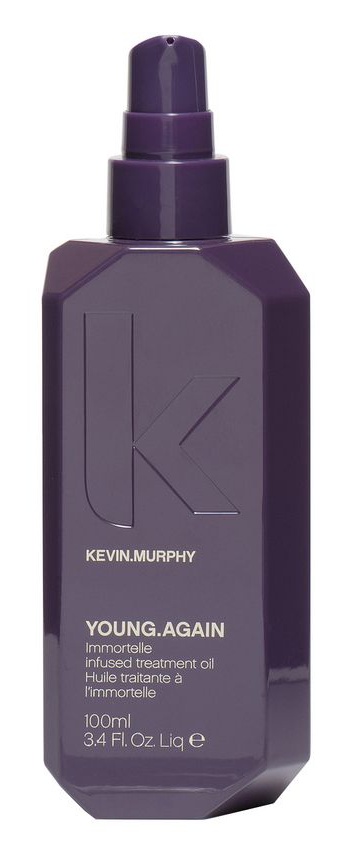
Young.Over again Oil
A rich yet weightless leave-in treatment oil that grants softening, moisturising and age-defying benefits. Like skin care for your hair, Kevin Potato'south professional person-standard range utilises the finest ingredients to deliver strength and health to your strands, ensuring that they look their very best – even if you lot're growing up a little quicker than you'd like (aren't we all!) Enriched with immortelle flower, burdock root oil and safflower seed oil, the luxuriously natural concoction is ideal for restoring youthful lustre to dry, brittle or damaged hair. Brimming with antioxidants, the gentle conditioner also guards confronting color fade and keeps tresses defended from the often harmful effects of the elements, as well as providing heat protection up to 200°F/93°C. Your locks will exist left sleek, chic and soft – without existence weighed down.
Uploaded by: mariana on
Ingredients overview
Cyclopentasiloxane, Dimethicone, Dimethiconol, Bis-Cetearyl Amodimethicone, Helichrysum Stoechas Extract, Carthamus Tinctorius (Safflower) Seed Oil, Pyrus Malus (Apple) Fruit Extract, Saccharum Officinarum (Sugarcane) Extract, Citrus Limon (Lemon) Peel Oil, Camellia Sinensis Foliage Extract, Citrus Limon (Lemon) Fruit Extract, Vitis Vinifera (Grape) Seed Extract, Ginkgo Biloba Leaf Excerpt, Hydrolyzed Soy Protein, Hexapeptide-11, Cyclohexasiloxane, Glycerin, Cetearyl Alcohol, Betaine, Myristyl Myristate, Quaternium-91, Vinyl Butyl Ether, H2o (Aqua) (Eau), Behentrimonium Chloride, Butylene Glycol, Hexylene Glycol, Ethylhexyl Methoxycinnamate, BHT, Phenoxyethanol, Potassium Sorbate, Fragrance (Parfum), Linalool, Limonene, Geraniol, Hydroxyisohexyl iii-Cyclohexene Carboxaldehyde, Violet 2 (Ci 60725)
Highlights
Key Ingredients
Other Ingredients
Skim through
| Ingredient name | what-it-does | irr., com. | ID-Rating |
|---|---|---|---|
| Cyclopentasiloxane | emollient, solvent | ||
| Dimethicone | emollient | 0, ane | |
| Dimethiconol | emollient, moisturizer/humectant | ||
| Bis-Cetearyl Amodimethicone | |||
| Helichrysum Stoechas Extract | |||
| Carthamus Tinctorius (Safflower) Seed Oil | antioxidant, emollient | 0, 0-two | goodie |
| Pyrus Malus (Apple tree) Fruit Extract | moisturizer/humectant | goodie | |
| Saccharum Officinarum (Sugarcane) Extract | moisturizer/humectant | goodie | |
| Citrus Limon (Lemon) Pare Oil | perfuming | icky | |
| Camellia Sinensis Leafage Extract | antioxidant, soothing | goodie | |
| Citrus Limon (Lemon) Fruit Extract | |||
| Vitis Vinifera (Grape) Seed Extract | antioxidant, antimicrobial/antibacterial | goodie | |
| Ginkgo Biloba Leaf Extract | |||
| Hydrolyzed Soy Protein | moisturizer/humectant | ||
| Hexapeptide-11 | |||
| Cyclohexasiloxane | emollient, solvent | ||
| Glycerin | skin-identical ingredient, moisturizer/humectant | 0, 0 | superstar |
| Cetearyl Alcohol | emollient, viscosity decision-making, emulsifying, surfactant/cleansing | i, ii | |
| Betaine | moisturizer/humectant | goodie | |
| Myristyl Myristate | emollient | 2, 0-five | |
| Quaternium-91 | |||
| Vinyl Butyl Ether | |||
| H2o (Aqua) (Eau) | solvent | ||
| Behentrimonium Chloride | preservative | ||
| Butylene Glycol | moisturizer/humectant, solvent, viscosity controlling | 0, one | |
| Hexylene Glycol | solvent, emulsifying, perfuming, surfactant/cleansing | 0-1, 0-2 | |
| Ethylhexyl Methoxycinnamate | sunscreen | 0, 0 | |
| BHT | antioxidant, preservative | ||
| Phenoxyethanol | preservative | ||
| Potassium Sorbate | preservative | ||
| Fragrance (Parfum) | perfuming | icky | |
| Linalool | perfuming | icky | |
| Limonene | perfuming, solvent | icky | |
| Geraniol | perfuming | icky | |
| Hydroxyisohexyl 3-Cyclohexene Carboxaldehyde | perfuming | ||
| Violet 2 (Ci 60725) | colorant |
Kevin Murphy Young.Again Oil
Ingredients explainedA super normally used v unit of measurement long, circadian structuredsilicone that is water-thin and does not stay on the skin but evaporates from it (called volatile silicone). Similar to other silicones, information technology gives skin and pilus a silky, smooth feel.
It's frequently combined with the non-volatile (i.e. stays on the peel) dimethicone equally the two together form a h2o-resistant, breathable protective barrier on the peel without a negative tacky feel.
What-it-does: emollient | Irritancy: 0 | Comedogenicity: 1
Probably themost common silicone of all. It is a polymer (created from repeating subunits) molecule and has different molecular weight and thus different viscosity versions from water-light to thick liquid.
As for skincare, it makes the skin silky shine, creates a subtle gloss and forms a protective barrier (aka occlusive). Too, works well to fill in fine lines and wrinkles and requite skin a plump expect (of course that is simply temporary, but still, information technology's nice). There are also scar treatment gels out there using dimethicone as their base ingredient. It helps to soften scars and increment their elasticity.
As for hair care, it is a non-volatile silicone meaning that information technology stays on the pilus rather than evaporates from information technology andsmoothes the hair like no other thing. Depending on your hair type, it can exista bit difficult to wash out and might cause some build-up (btw, this is not true to all silicones, only the not-volatile types).
A thick, high molecular weight silicone that is usually diluted in some other, lighter silicone fluid (similar dimethicone or cyclopentasiloxane). The dimethiconol containing silicone blends leave a silky smooth, non-greasy moving picture on the skin.
 We don't have clarification for this ingredient all the same.
Besides-called: Helichrysum Extract
We don't have description for this ingredient however.
As well-called: Safflower Seed Oil | What-it-does: antioxidant, emollient | Irritancy: 0 | Comedogenicity: 0-2
The oil coming from the seeds of the xanthous flowered safflower establish. Like to other institute oils, it'southward loaded withnourishing and moisturizing fatty acids: it'due south a high linoleic acid oil (70%) and has only smaller amounts of oleic acrid (xi%) (this might be peachy for acne-decumbent skin). Information technology likewise contains antioxidant vitamin E (44mg/100g blastoff-tocopherol).
Apple tree needs no introduction as one of the most mutual fruits on planet Earth. It's not just a good for you fruit snack, it'due south also a goodie if you put in all over your face.
It's loaded with proteins, starch, sugars, acids, vitamins and salts. The sugars (mainly fructose, glucose, sucrose) requite apple tree fruit excerpt nice moisturizing and smoothing properties, while the acids (mainly malic and gallic acrid) give it mild exfoliant, pare brightening and antibacterial properties.
Also known every bit Sugarcane, Saccharum Officinarum is a handy moisturizing ingredient mostly used every bit a humectant. This ways that it can aid the pare to attract water then to concord onto it.
It bears a shut relationship to AHA superstar, Glycolic Acid that tin can be derived from information technology, so it'southward often claimed that Sugarcane Extract itself also exfoliates and brightens the skin. We could not detect any inquiry studies to back this up, but Saccharum Officinarum very frequently comes to the formula combined with other acrid containing constitute extracts trade named ACB Fruit Mix. According to manufacturer data, 5% of the fruit mix increases cellular renewal past 24%, while 4% pure Glycolic did the same past 33%. And then maybe, a tiny bit of exfoliation, but if you want proven efficacy, stick to pure acids.
Too-called: Lemon Peel Oil | What-it-does: perfuming
The essential oil coming from the rind of the lemon that we make (or should make) lemonade from. In general, there are two problems with citrus peel oils: start, they are essentially the fragrant component, limonene in disguise (they are about 85-98% limonene).
Second, they comprise the problematic compounds called furanocoumarins that make them mildly phototoxic. Lemon skin contains a medium corporeality of them, more than than sweet orangish but less than bergamot. Be careful with information technology especially if it is in a product for daytime use.
- Greenish tea is one of the most researched natural ingredients
- The active parts are called polyphenols, or more precisely catechins (EGCG beingness the most abundant and about agile catechin)
- There can be huge quality differences between green tea extracts. The good ones comprise 50-xc% catechins (and often make the product brown and give information technology a distinctive smell)
- Green tea is proven to be a slap-up antioxidant, UV protectant, anti-inflammatory, anticarcinogenic and antimicrobial
- Because of these crawly backdrop light-green tea is a bang-up choice for anti-aging and also for peel diseases including rosacea, acne and atopic dermatitis
Read all the geeky details nearly Camellia Sinensis Foliage Extract here >>
Too-called: Lemon Fruit Extract
If life gives the cosmetic manufacture lemon, it makes lemon fruit extract. Every bit to why, we can write here extremely similar things to our shiny description of orange fruit extract. Being both of them citruses, they contain very similar active compounds with very similar (potential) effects on the skin.
Just like orangish fruit, lemon fruit too containscitric acid so it is commonly used as anatural, mild exfoliating agent. If this is the case, it is ordinarily combined with other AHA containing fruit extracts such as bilberry, saccharide cane, orangish, and saccharide maple in a super popular ingredient mix merchandise named ACB Fruit Mix.
Only, citrus fruits are chemically complex mixtures with a bunch of other active components such equally vitamin C, flavonoids, phenolics, carbohydrates and essential oil (this latter ane coming from the rind of the fruit, but yet present in some corporeality in the fruit extract). These have the potential to requite lemon excerpt antioxidant, antibacterial, anti-dandruff, venotonic and moisturizing backdrop, only the essential oil also brings some questionable compounds such equally fragrance allergen limonene or phototoxic chemical compound bergaptene. If your pare is sensitive, be conscientious with citrus extracts.
We wholeheartedly support the ascent of seedless grapes as fruit snacks, merely when it comes to skincare, we are large fans of the seeds.
They contain the majority of the skin goodiesthat - similar to greenish tea - are generally polyphenols (but not the same ones as in tea). The about arable ones in grape are called proanthocyanidins, and 60-lxx% of them are institute in the seeds (it's also often abbreviated as GSP - grape seed proanthocyanidins). In general, the darker the fruit, the more than GSPs and other flavonoids it contains.
So what'southward so special about GSPs? Well, they aresuper-potent antioxidants, much stronger than Vitamin C or Vitamin E. And if that's not plenty, GSPs and other flavonoids in grape also prove UV protecting and anti-cancer properties.
It'due south definitely a goodie to spot on the INCI list.
Also-chosen: Ginkgo Biloba Extract
We don't accept clarification for this ingredient however.
Nosotros don't have clarification for this ingredient yet.
We don't have description for this ingredient nonetheless.
A low-cal-feeling, volatile (significant it does not blot into the skin but evaporates from information technology) silicone that gives skin a unique, silky and non-greasy feel. Information technology has fantabulous spreading properties and leaves no oily remainder or build-upward.
- A natural moisturizer that's likewise in our skin
- A super mutual, prophylactic, effective and cheap molecule used for more than l years
- Not but a simple moisturizer but knows much more: keeps the skin lipids between our skin cells in a healthy (liquid crystal) state, protects against irritation, helps to restore barrier
- Effective from as low as 3% with even more benefits at college concentrations up to twenty-40% (effectually x% is a good usability-effectiveness sweet spot)
- High-glycerin moisturizers are awesome for treating severely dry pare
Read all the geeky details almost Glycerin hither >>
An extremely common multitasker ingredient that gives your skin a nice soft experience (emollient) and gives body to creams and lotions. It also helps to stabilize oil-water mixes (emulsions), though it does not function equally an emulsifier in itself. Its typical use level in virtually cream type formulas is 2-3%.
It's a so-chosen fatty alcohol, a mix of cetyl and stearyl alcohol, other two emollient fatty alcohols. Though chemically speaking, information technology is booze (every bit in, it has an -OH group in its molecule), its properties are totally dissimilar from the properties of depression molecular weight or drying alcohols such equally denat. booze. Fatty alcohols have a long oil-soluble (and thus emollient) tail function that makes them absolutely non-drying and non-irritating and are totally ok for the pare.
A carbohydrate beet derived amino acid derivative with nice skin protection and moisturization properties. Betain's special affair is being an osmolyte, a molecule that helps to command cell-water balance. It is besides a natural osmoprotectant, meaning that information technology attracts h2o away from the protein surface and thus protects them from denaturation and increases their thermodynamic stability.
It too gives sensorial benefits to the formula and when used in cleansers, it helps to brand them milder and gentler.
What-it-does: emollient | Irritancy: two | Comedogenicity: 0-v
It'southward a waxy emollient with a melting point near to pare temperature. It gives torso and consistency to the formula and leaves a velvety experience on the skin.
Information technology has a loftier comedogenicity index (5 out of 5), so it might clog pores if yous are prone to it. Famous dermatologist, Dr. Leslie Baumann also writes in her volume, The Skin Type Solution to avoid this ingredient if you are acne-prone.
We don't have clarification for this ingredient however.
This ingredient name is not according to the INCI-standard. :( What, why?!
Also-chosen: Aqua | What-information technology-does: solvent
Expert old h2o, aka H2o. The most common skincare ingredient of all. You can usually find it right in the very first spot of the ingredient list, meaning information technology's the biggest thing out of all the stuff that makes up the product.
It'due south mainly a solvent for ingredients that do not similar to dissolve in oils simply rather in water.
Once inside the pare, information technology hydrates, just not from the outside - putting pure water on the skin (hello long baths!) is drying.
One more affair: the h2o used in cosmetics is purified and deionized (it means that virtually all of the mineral ions within it is removed). Like this, the products tin stay more stable over fourth dimension.
We don't have description for this ingredient yet.
Butylene glycol, or let'due south merely call it BG, is a multi-tasking colorless, syrupy liquid. Information technology's a great selection for creating a overnice feeling product.
BG'southward main task is usually to exist a solvent for the other ingredients. Other tasks include helping the production to absorb faster and deeper into the pare (penetration enhancer), making the product spread nicely over the pare (slip agent), and attracting water (humectant) into the skin.
It's an ingredient whose safety hasn't been questioned and then far past anyone (at least not that we know nearly). BG is approved by Ecocert and is also used enthusiastically in natural products. BTW, it's also a food additive.
Like to other glycols, it's a helper ingredient used as a solvent, or to sparse out thick formulas and brand them more nicely spreadable.
Hexylene Glycol is also part a preservative blend named Lexgard® HPO, where it helps the effectiveness of current IT-preservative, phenoxyethanol.
Also-chosen: Octinoxate, Octyl Methoxycinnamate | What-it-does: sunscreen | Irritancy: 0 | Comedogenicity: 0
A clear, oil-soluble, "cosmetically-elegant" liquid that is the most commonly usedchemic sunscreen. It absorbs UVB radiation (at wavelengths: 280-320 nm) with a tiptop protection at 310nm.
It just protects against UVB and not UVA rays (the 320-400 nm range) – so ever cull products that contain other sunscreens also. It isnot very stable either, when exposed to sunlight, it kind of breaks down and loses its effectiveness (not instantly, just over time - it loses ten% of its SPF protection ability within 35 mins). To make information technology more than stable information technology tin exist - and should be - combined with other sunscreen agents to give stable and broad-spectrum protection (the new generation sunscreen amanuensis, Tinosorb S is a particularly practiced i for that).
Regarding condom, there are likewise some concerns around Octinoxate. In vitro (made in the lab not on existent people) and animal studies have shown that it may produce hormonal (estrogen-like) effects.Do not panic, the studies were not conducted under real life conditions on real human people, and so information technology is probably over-cautious to avoid Octinoxate altogether. Even so, if y'all are pregnant or a small child (under 2 yrs. onetime), choose a physical (zinc oxide/titanium dioxide) or new-generation Tinosorb based sunscreen, but to be on the super-safe side. :)
Overall, Ethylhexyl Methoxycinnamate is an quondam-school chemic sunscreen agent. At that place are plenty of improve options for sun protection today, but it is considered "safe as used" (and sunscreens are pretty well regulated) and it is available worldwide (tin exist used up to ten% in the EU and up to 7.5% in the United states of america).
It's the acronym for Butylated Hydroxy Toluene. Information technology's a mutual synthetic antioxidant that's used as a preservative.
There is some controversy around BHT. It'southward not a new ingredient, information technology has been used both as a nutrient and cosmetics additive since the 1970s. Enough of studies tried to examine if it'south a carcinogen or not. This Truth in Crumbling article details the state of affairs and also writes that all these studies examine BHT when taken orally.
As for cosmetics, the CIR (Cosmetic Ingredient Review) ended that the corporeality of BHT used in corrective products is low (usually around 0.01-0.one%), it does not penetrate skin far enough to exist absorbed into the bloodstream and it is safe to use in cosmetics.
It'due south pretty much the electric current IT-preservative. Information technology's safety and gentle, but fifty-fifty more importantly, it's not a feared-by-anybody-mostly-without-scientific-reason paraben.
It'southward not something new: it was introduced around 1950 and today information technology can be used upwardly to one% worldwide. Information technology tin be institute in nature - in green tea - but the version used in cosmetics is synthetic.
Other than having a good safe profile and beingness quite gentle to the skin it has some other advantages too. Information technology can exist used in many types of formulations every bit it has swell thermal stability (tin be heated up to 85°C) and works on a wide range of pH levels (ph 3-10).
It'south often used together with ethylhexylglycerin as it nicely improves the preservative activity of phenoxyethanol.
It'southward i of those things that help your cosmetics not to get wrong too soon, aka a preservative. Information technology's not a strong one and doesn't really work confronting leaner, just more confronting mold and yeast. To practise that it has to suspension downwards to its agile form, sorbic acid. For that to happen, in that location has to be water in the product and the right pH value (pH 3-4).
But fifty-fifty if everything is right, it'southward not enough on its own. If you see potassium sorbate yous should see some other preservative side by side to it as well.
BTW, it'south also a food preservative and even has an E number, E202.
Also-called: Fragrance, Parfum;Parfum/Fragrance | What-information technology-does: perfuming
Exactly what information technology sounds: nice smelling stuff put into corrective products so that the cease product besides smells nice. Fragrance in the US and parfum in the EU is a generic term on the ingredient list that is fabricated up of 30 to 50 chemicals on average (simply information technology tin have equally much as 200 components!).
If you are someone who likes to know what you put on your face up then fragrance is not your best friend - there'due south no way to know what's really in information technology.
Also, if your skin is sensitive, fragrance is once again not your best friend. It's the number one cause of contact allergy to cosmetics. It'southward definitely a smart thing to avoid with sensitive skin (and fragrance of any type - natural is just as allergic as synthetic, if non worse!).
Linalool is a super mutual fragrance ingredient. It'southward kind of everywhere - both in plants and in corrective products. It's role of 200 natural oils including lavender, ylang-ylang, bergamot, jasmine, geranium and it can exist constitute in xc-95% of prestige perfumes on the market.
The problem with linalool is, that just like limonene it oxidises on air exposure and becomes allergenic. That's why a product containing linalool that has been opened for several months is more likely to exist allergenic than a fresh one.
A written report made in the U.k. with 483 people tested the allergic reaction to three% oxidised linalool and 2.three% had positive test results.
A supermutual and cheap fragrance ingredient. It'southward in many plants, east.grand. rosemary, eucalyptus, lavander, lemongrass, peppermint and it'south the primary component (most 50-90%) of the pare oil of citrus fruits.
It does smell dainty simply the problem is that it oxidizes on air exposure and the resulting stuff is not expert for the peel. Oxidized limonene tin cause allergic contact dermatitis and counts as a frequent skin sensitizer.
Limonene's nr1 office is definitely being a fragrance component, just in that location are several studies showing that it'southward also a penetration enhancer, mainly for oil-loving components.
All in all, limonene has some pros and cons, but - particularly if your skin is sensitive - the cons probably outweigh the pros.
Geraniol is a common fragrance ingredient. It smells like rose and can be found in rose oil or in pocket-sized quantities in geranium, lemon and many other essential oils.
Just like other similar fragrance ingredients (like linalool and limonene) geraniol also oxidises on air exposure and becomes allergenic. Best to avert if you take sensitive skin.
Also-chosen: Lyral | What-information technology-does: perfuming
We don't take description for this ingredient yet.
Likewise-called: Ci 60725 | What-it-does: colorant
We don't have description for this ingredient yet.
Y'all may also want to accept a look at...
It'due south a super unremarkably used water-thin volatile silicone that gives pare and hair a silky, smoothen feel. [more] A very common silicone that gives both peel and hair a silky smooth feel. It also forms a protective barrier on the pare and fills in fine lines. Also used for scar handling. [more] A thick, loftier molecular weight silicone that is normally diluted in a lighter silicone fluid. The dimethiconol containing silicone blends leave a silky smooth, non-greasy film on the skin. [more] Safflower Seed Oil - emollient establish oil with moisturizing fat acids (linoleic: 70%, oleic: xi%) and antioxidant vitamin E (44mg/100g blastoff-tocopherol). [more] The essential oil coming from the rind of the lemon. Its main component (83-97%) is limonene, the super common fragrant ingredient. [more] A light-feeling, volatile silicone that gives peel a unique, silky and not-greasy feel. It has excellent spreading backdrop and leaves no oily residue or build-upward. A real oldie but a goodie. Great natural moisturizer and peel-identical ingredient that plays an important role in peel hydration and general pare health. [more] A super common multitasker ingredient that gives your skin a nice soft feel (emollient) and gives body to creams. [more] A sugar beet derived amino acid derivative with prissy peel protection and moisturization backdrop. Its special thing is being an osmolyte, a molecule that helps to control cell-water balance. [more] It's a waxy emollient with a melting point near to skin temperature. It gives trunk and consistency to the formula and leaves a velvety feel on the skin. Information technology has a loftier comedogenicity index (5 out of 5), so it might clog pores if yous are prone to it. [more] Normal (well kind of - it'southward purified and deionized) h2o. Usually the main solvent in corrective products. [more than] An often used glycol that works as a solvent, humectant, penetration enhancer and also gives a good slip to the products. [more than] Similar to other glycols, information technology's a helper ingredient used every bit a solvent, or to thin out thick formulas and brand them more than nicely spreadable. Hexylene Glycol is also part a preservative alloy named Lexgard® [more] Octinoxate - an quondam-school chemical sunscreen that absorbs UVB radiation (wavelengths: 280-320 nm). Non photostable and does not protect against UVA. [more] It'due south the acronym for Butylated Hydroxy Toluene. It's a common synthetic antioxidant that's used as a preservative.There is some controversy around BHT. [more] Pretty much the current It-preservative. It's safety and gentle, and can exist used up to 1% worldwide. [more than] A non and then stiff preservative that doesn't actually work against leaner, simply more against mold and yeast. [more] The generic term for nice smelling stuff put into cosmetic products and so that the cease product also smells nice. Information technology is fabricated up of 30 to 50 chemicals on boilerplate. [more] A super common fragrance ingredient that can exist found among others in lavander, ylang-ylang, bergamot or jasmine. The downside of it is that information technology oxidises on air exposure and might get allergenic. [more than] A super common fragrance ingredient establish naturally in many plants including citrus pare oils, rosemary or lavender. Information technology autoxidizes on air exposure and counts as a common skin sensitizer. [more] A common fragrance ingredient that smells like rose and can be found in rose oil. [more than]
mcdanielhason1965.blogspot.com
Source: https://incidecoder.com/products/kevin-murphy-young-again-oil
0 Response to "Ingredients of Young Again Oil for Hair"
Post a Comment